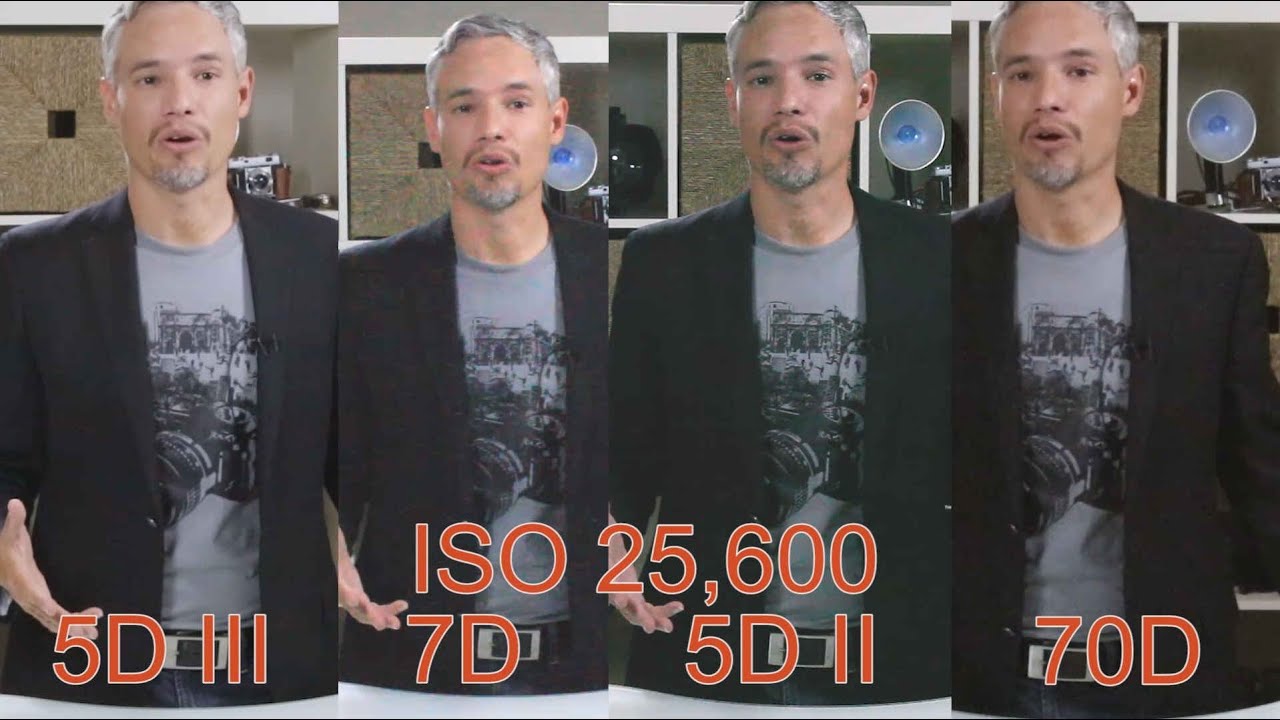
Every time a new mid-range Canon body drops, the same argument starts up in forums and comment sections: is it actually worth upgrading, or is the marketing team just doing its job? I’ve been on both sides of that debate more times than I can count. When I first started shooting video seriously, I was working with whatever body I could justify on a gear-budget that also had to cover rent. So when a camera like the Canon 70D shows up promising better autofocus, competitive low-light performance, and video quality that punches above its price tier, I want to see the receipts, not the press release.
That’s exactly what this tutorial delivers. In this Tony & Chelsea Northrup video, the team runs the 70D through a side-by-side gauntlet against the Canon 7D, 5D Mark II, and 5D Mark III, shooting identical scenes at matched settings to see where the 70D actually lands in the lineup. Watch the full tutorial on YouTube. What makes this review worth your time is that it doesn’t just declare a winner. It shows you the footage and explains what you’re actually looking at, which is a lot more useful when you’re trying to decide where to put your money.
The core question here isn’t whether the 70D beats a 5D Mark III. It doesn’t, and nobody expected it to. The real question is whether it replaces the 7D and whether it holds up well enough against the beloved 5D Mark II to justify its position in the market. Here’s what the tests actually show.
Step 1: Set Up the Controlled Comparison with Matched Exposure Settings
 Four Canon cameras side by side in outdoor shooting setup
Before any useful comparison can happen, every camera needs to be locked to the same exposure values. In this test, all four bodies are shooting at ISO 200, 1/130th of a second, and f/4 for the baseline daylight test. The lenses aren’t identical across all four cameras, since getting four of the exact same glass isn’t always realistic, but they’re all using kit-level lenses, which keeps the comparison grounded in how most buyers would actually use these bodies. If you run your own comparison tests, this is the discipline that makes your results mean something. Mixed settings produce mixed conclusions.
Four Canon cameras side by side in outdoor shooting setup
Before any useful comparison can happen, every camera needs to be locked to the same exposure values. In this test, all four bodies are shooting at ISO 200, 1/130th of a second, and f/4 for the baseline daylight test. The lenses aren’t identical across all four cameras, since getting four of the exact same glass isn’t always realistic, but they’re all using kit-level lenses, which keeps the comparison grounded in how most buyers would actually use these bodies. If you run your own comparison tests, this is the discipline that makes your results mean something. Mixed settings produce mixed conclusions.
Step 2: Evaluate Moire at Base ISO in Daylight
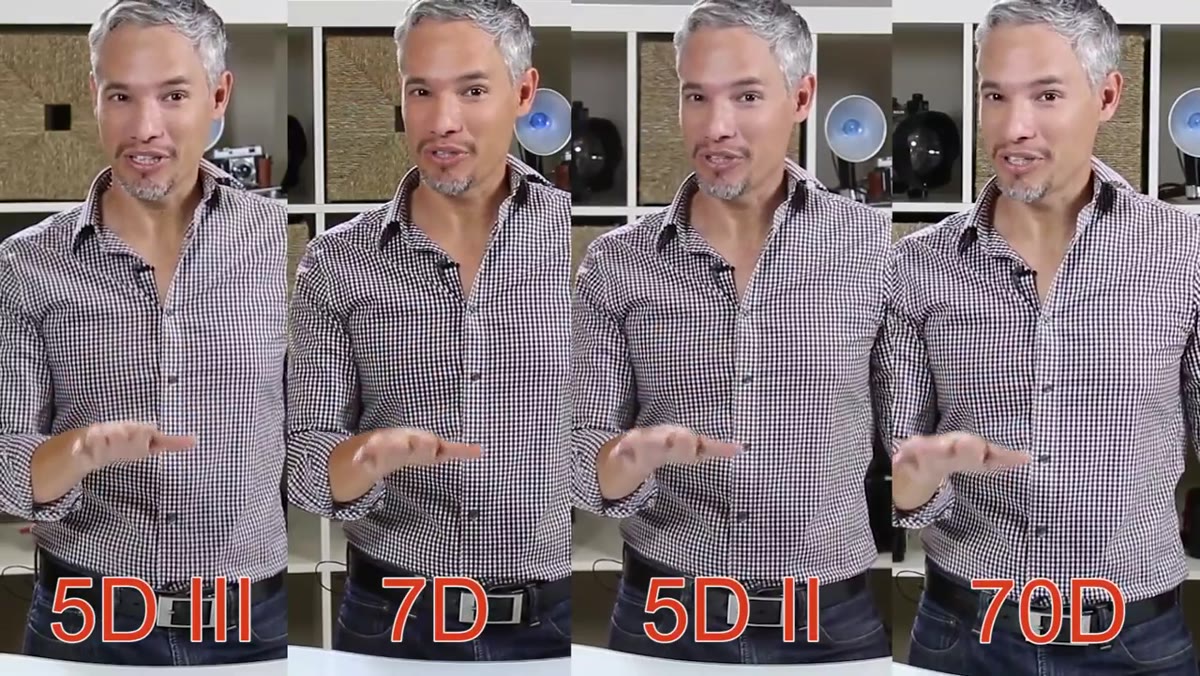
 Tony in striped shirt walking to trigger moire pattern
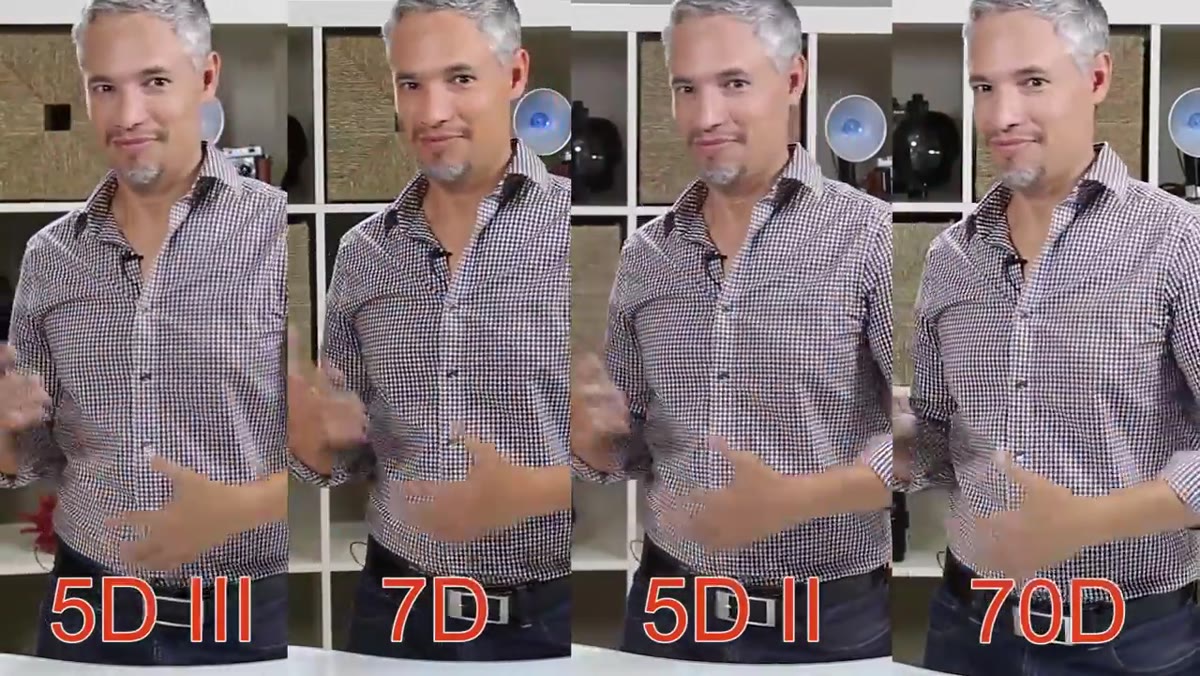
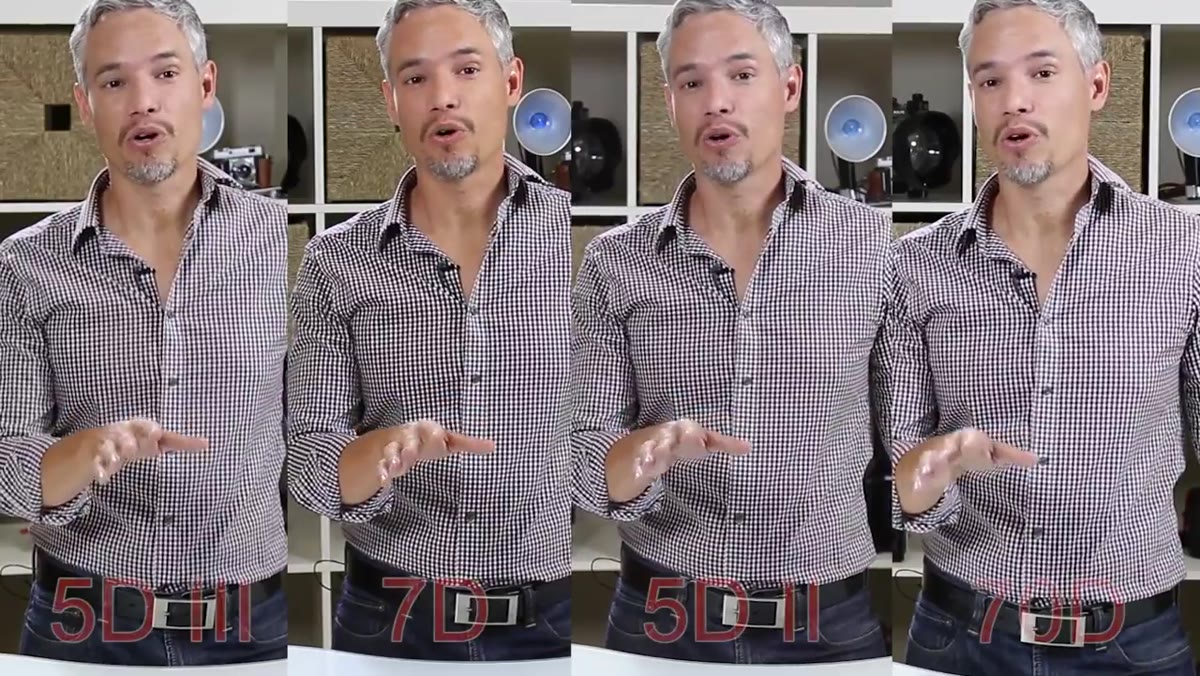
The first thing being tested is moire, which is that wavy, shimmering interference pattern that shows up when fine repeating patterns in a scene interact with the camera sensor’s pixel grid. To force it into the frame, Tony wears a tightly patterned striped shirt, which is about as direct a stress test as you can run. At ISO 200 in daylight, the 70D shows roughly similar moire behavior to the 5D Mark II and the 7D. The 5D Mark II edges ahead as the cleaner result here, but the gap is not dramatic.
Tony in striped shirt walking to trigger moire pattern
The first thing being tested is moire, which is that wavy, shimmering interference pattern that shows up when fine repeating patterns in a scene interact with the camera sensor’s pixel grid. To force it into the frame, Tony wears a tightly patterned striped shirt, which is about as direct a stress test as you can run. At ISO 200 in daylight, the 70D shows roughly similar moire behavior to the 5D Mark II and the 7D. The 5D Mark II edges ahead as the cleaner result here, but the gap is not dramatic.
What’s worth internalizing is the point made about moire being largely a production problem, not a camera problem. You can control it by managing what subjects wear and how you frame architecture-heavy shots. If the 6D review complaints about moire felt like dealbreakers to some buyers, Tony’s right that most of those people were overweighting a manageable variable.
Step 3: Move Into the Low-Light Test at ISO 800
 Indoor low-light scene, dark jacket showing shadow noise
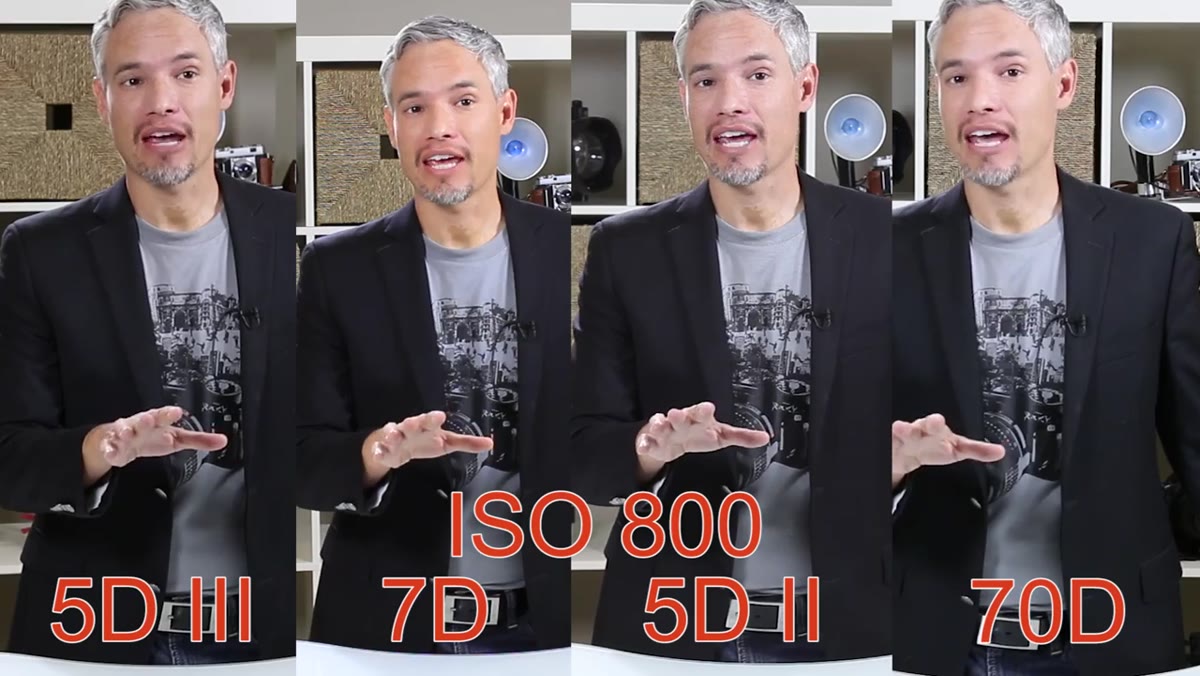
With the exposure shifted to ISO 800 and f/8, the test moves indoors and shadow noise becomes the thing to watch. Dark fabric and background objects are the areas where crop sensor cameras tend to fall apart relative to full-frame bodies. At this setting, the differences between the 70D and the 5D Mark III start to become more visible, but the 70D still holds its own compared to the 7D. This is the range most event and documentary videographers actually shoot in, so paying close attention here matters more than the base ISO results.
Indoor low-light scene, dark jacket showing shadow noise
With the exposure shifted to ISO 800 and f/8, the test moves indoors and shadow noise becomes the thing to watch. Dark fabric and background objects are the areas where crop sensor cameras tend to fall apart relative to full-frame bodies. At this setting, the differences between the 70D and the 5D Mark III start to become more visible, but the 70D still holds its own compared to the 7D. This is the range most event and documentary videographers actually shoot in, so paying close attention here matters more than the base ISO results.
If you shoot in mixed or dim ambient light regularly, this segment is the one to rewatch. The shadow regions are your signal. That’s where sensor size and read noise separation between crop and full-frame bodies becomes real and visible.
Step 4: Push to ISO 3200 and Watch Noise Accumulate
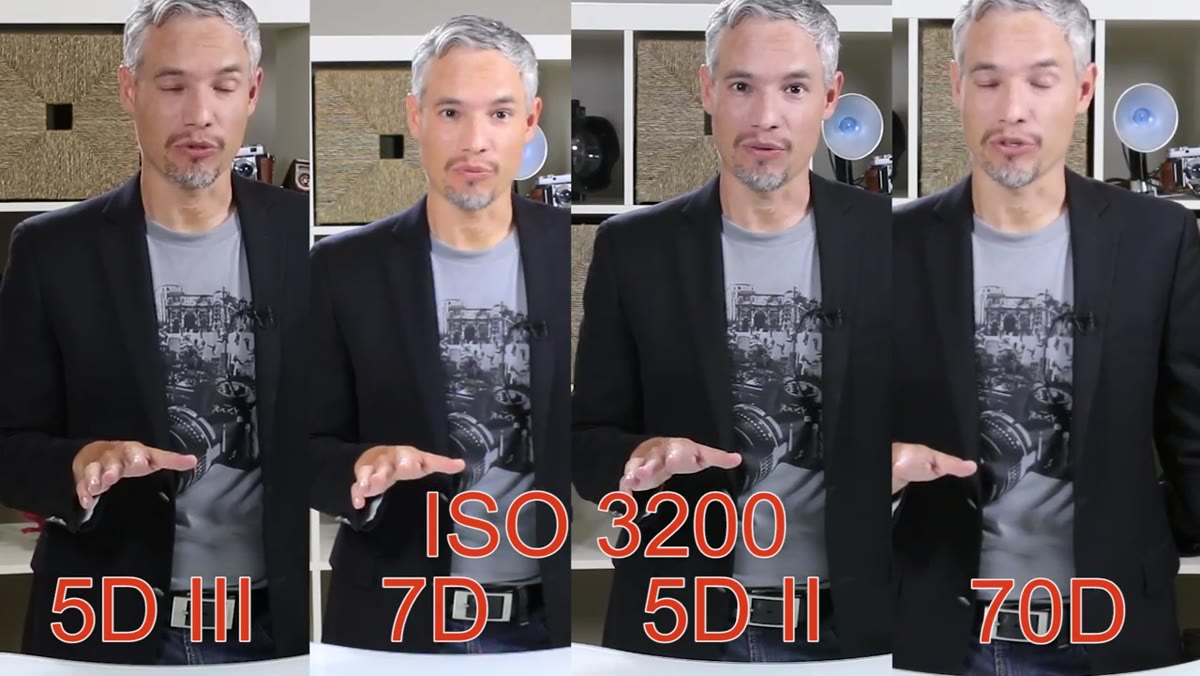 ISO 3200 test footage showing visible grain in shadows
At ISO 3200 with f/16, all four cameras are being pushed hard enough that noise is visible to anyone watching in 1080p. The advice here is to watch this specific section at full resolution, not in a compressed preview window. Noise that looks acceptable at 720p can be genuinely distracting at 1080p, especially if your footage is going anywhere near a large display or a client review screen. The 70D shows crop-sensor noise behavior here, which is expected. The full-frame bodies hold shadow detail noticeably better at this ISO ceiling.
ISO 3200 test footage showing visible grain in shadows
At ISO 3200 with f/16, all four cameras are being pushed hard enough that noise is visible to anyone watching in 1080p. The advice here is to watch this specific section at full resolution, not in a compressed preview window. Noise that looks acceptable at 720p can be genuinely distracting at 1080p, especially if your footage is going anywhere near a large display or a client review screen. The 70D shows crop-sensor noise behavior here, which is expected. The full-frame bodies hold shadow detail noticeably better at this ISO ceiling.
For anyone shooting in situations where you have no control over ambient light, this comparison is a useful reality check about what you’re actually buying when you step up from a crop sensor to a full-frame body.
Step 5: Assess Where the 70D Actually Lands Against the 7D
 Split-screen footage comparison between 70D and 7D
The 7D was a benchmark for Canon’s crop-sensor performance for years. Based on the footage comparisons here, the 70D matches or outperforms it in video quality across the tested scenarios. More importantly, the 70D brings Dual Pixel CMOS autofocus to the table, which is a meaningful practical upgrade for anyone shooting video with a single operator setup. Continuous, reliable AF during video recording was a real weakness of DSLRs for a long time. The Dual Pixel system changes that equation in a way that matters on an actual shoot.
Split-screen footage comparison between 70D and 7D
The 7D was a benchmark for Canon’s crop-sensor performance for years. Based on the footage comparisons here, the 70D matches or outperforms it in video quality across the tested scenarios. More importantly, the 70D brings Dual Pixel CMOS autofocus to the table, which is a meaningful practical upgrade for anyone shooting video with a single operator setup. Continuous, reliable AF during video recording was a real weakness of DSLRs for a long time. The Dual Pixel system changes that equation in a way that matters on an actual shoot.
The conclusion here is essentially that if you own a 7D and shoot video, the 70D is a genuine generational step forward. It’s not a marginal update.
What Budget Shooters Should Actually Take From This
I ran a blind test at a local meetup a while back where nobody could identify which stills came from a $500 body versus a $2,000 one. Video comparisons like this one remind me of the same principle: the differences are real, but they’re contextual. The 70D losing to the 5D Mark III at ISO 3200 is not a reason to dismiss it. It’s information about which scenarios it handles confidently and which ones it doesn’t.
If your budget puts the 70D in reach and the 5D Mark III isn’t, the Dual Pixel AF alone makes a strong case for the 70D over the 7D or an older body. Full-frame noise performance is better, yes. But autofocus that actually tracks your subject during a video take is something you’ll use on every single shoot.
The single most important thing this comparison teaches is that video camera selection is almost always about matching a body’s specific strengths to the conditions you actually shoot in most often. The 70D is not the best Canon body for high-ISO low-light video. It is, however, a very capable mid-range video camera with a genuinely useful autofocus system that its direct competitors at the time couldn’t match. That’s a real value proposition.
Watch the full tutorial on YouTube to see the actual footage comparisons at each ISO level and judge the moire and noise results for yourself.
Comments
Leave a Comment