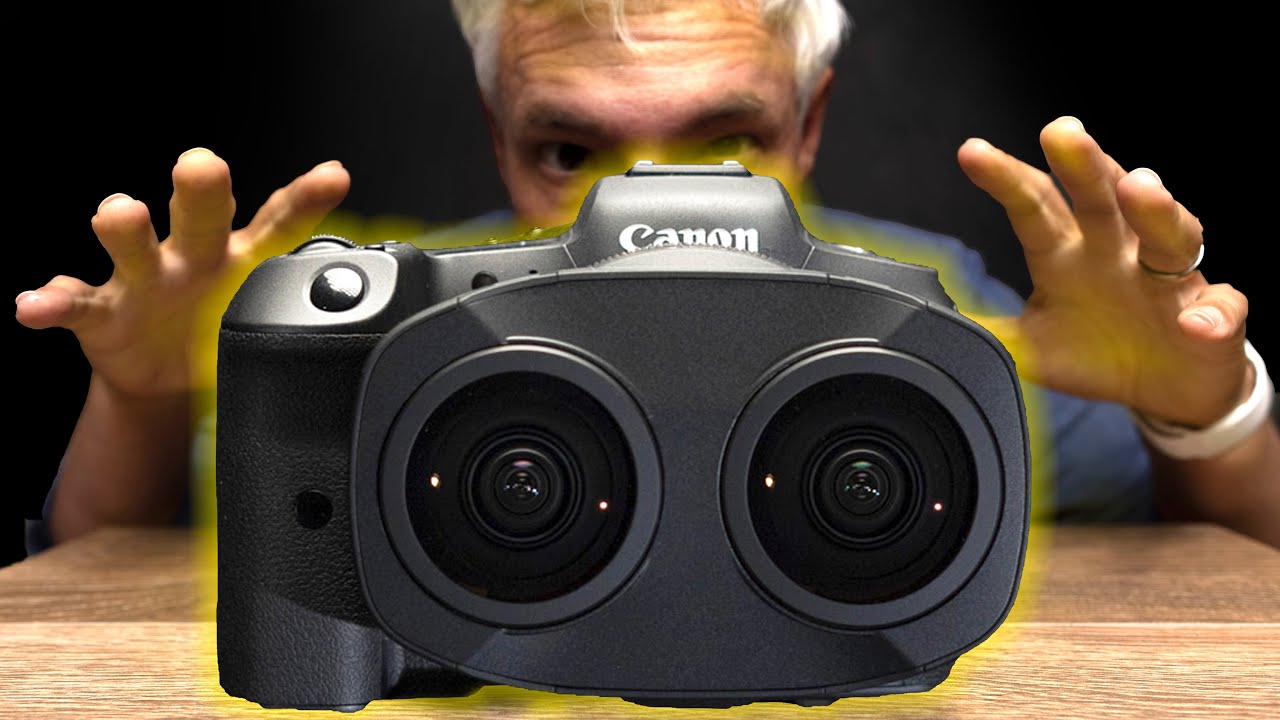
I’ll be honest: when I first heard “5.2mm f/2.8 double lens,” I assumed it was some kind of April Fool’s joke Canon forgot to schedule properly. A dual-lens system for shooting virtual reality content on a mirrorless body? That sounds like something from a trade show floor that never ships. But Canon shipped it. And after watching Tony and Chelsea Northrup dig into it, I came away thinking this is one of those pieces of gear that’s either ten years early or right on time, and the difference matters a lot depending on how you shoot.
I cover budget gear. My whole thing is finding the $80 lens that embarrasses the $400 one. So why am I writing about a Canon specialty lens that costs more than most people’s entire camera kits? Because the underlying concept here, capturing immersive 3D memories rather than flat video clips, is one I’ve been quietly obsessed with. I shoot a lot of family and event work, and the idea that footage could one day feel like you’re actually inside the moment rather than watching it through a window is genuinely compelling to me. In this Watch the full tutorial on YouTube Tony and Chelsea Northrup break down exactly what this lens does, how VR capture actually works, and why 180 VR might be the smarter format over the flashier 360 VR most people picture when they hear “virtual reality camera.”
Here’s the walkthrough of what they cover and what you need to understand if you’re thinking about jumping into VR content creation.
Step 1: Understand What This Lens Actually Is
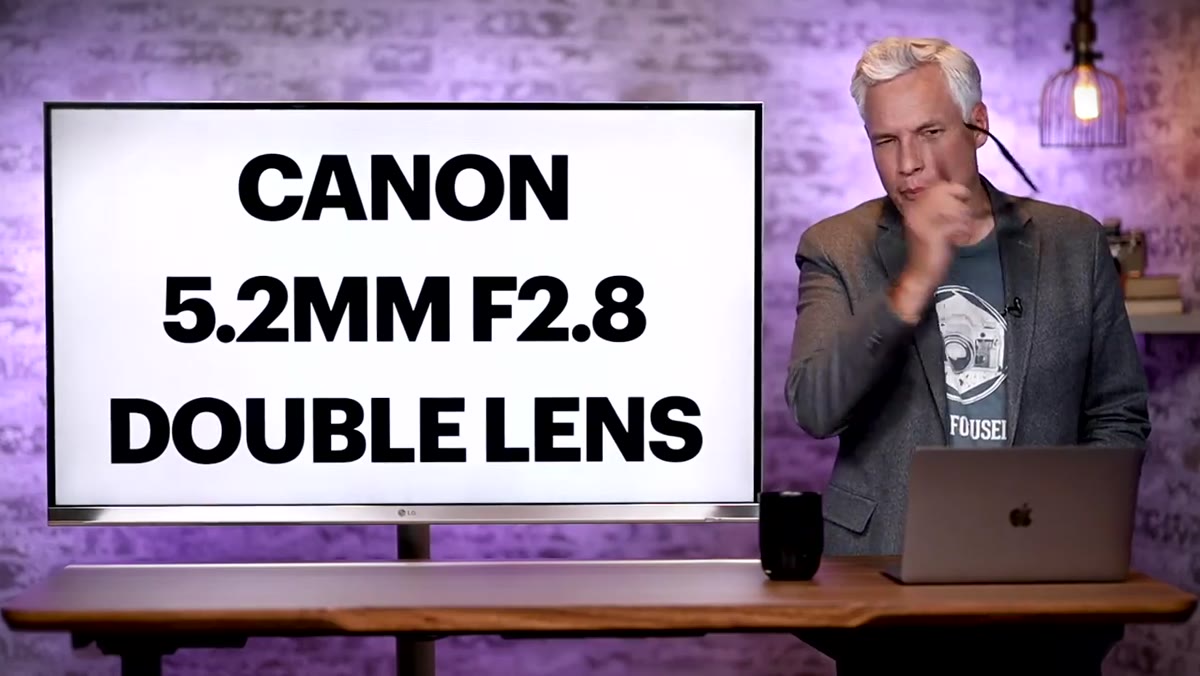 Canon’s bizarre 5.2mm dual-lens mounted on an RF camera body
This is not a fisheye. This is not a creative effect lens. The Canon RF 5.2mm f/2.8 L Dual Fisheye is a single physical lens with two optical systems built side by side, each capturing its own image circle. The spacing between the two lenses is designed to approximate the distance between a pair of human eyes. That spacing is the key. It’s what creates genuine stereoscopic 3D depth when the footage is processed and played back in a VR headset.
Canon’s bizarre 5.2mm dual-lens mounted on an RF camera body
This is not a fisheye. This is not a creative effect lens. The Canon RF 5.2mm f/2.8 L Dual Fisheye is a single physical lens with two optical systems built side by side, each capturing its own image circle. The spacing between the two lenses is designed to approximate the distance between a pair of human eyes. That spacing is the key. It’s what creates genuine stereoscopic 3D depth when the footage is processed and played back in a VR headset.
Think of it like your eyes: each one sees a slightly different angle of the same scene, and your brain stitches that into a sense of depth. This lens replicates that mechanically so a VR headset can do the same thing for your viewer.
Step 2: Know the Difference Between 180 VR and 360 VR
 Side-by-side diagram comparing 180 VR and 360 VR capture fields
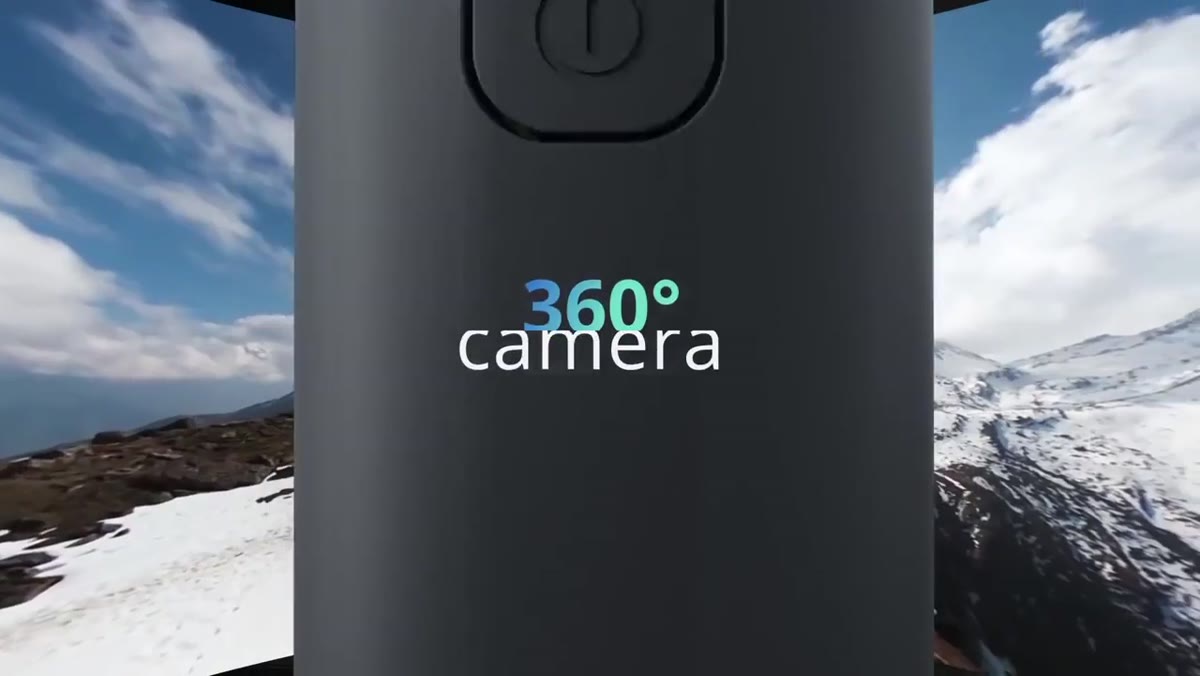
A lot of people conflate 180 VR with 360 VR, and they are genuinely different products for different use cases. The Canon lens is a 180 VR system, meaning it captures only what’s in front of the camera. You can’t look behind you. The tradeoff is that it’s stereoscopic, meaning it’s actually three-dimensional. Most 360 VR cameras capture the full sphere around you but sacrifice the 3D effect entirely.
Side-by-side diagram comparing 180 VR and 360 VR capture fields
A lot of people conflate 180 VR with 360 VR, and they are genuinely different products for different use cases. The Canon lens is a 180 VR system, meaning it captures only what’s in front of the camera. You can’t look behind you. The tradeoff is that it’s stereoscopic, meaning it’s actually three-dimensional. Most 360 VR cameras capture the full sphere around you but sacrifice the 3D effect entirely.
Tony makes a sharp point here that stuck with me: 360 VR is disorienting for narrative content because you never know where to look. If you’re filming a concert, a speech, or a family gathering, 180 VR keeps the viewer’s attention focused on the scene you actually composed. It also makes production dramatically easier because your crew, your lights, and your gear can stay behind the camera without showing up in the shot. With 360 you have to evacuate the entire space.
Step 3: Look at the History of 3D to Set Realistic Expectations
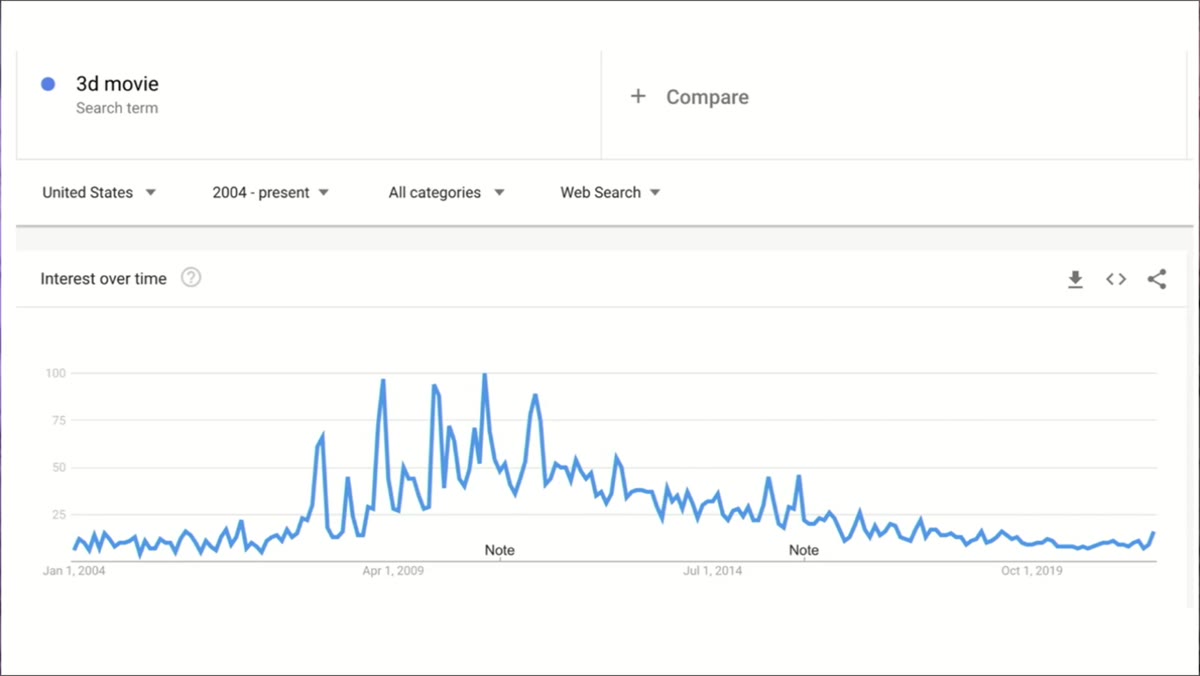 Google Trends graph showing 3D movie search spike from 2008 to 2012
Before you spend serious money on any VR capture system, you need to sit with the historical parallel Tony raises. He pulls up Google Trends data showing 3D movie interest, and the picture is sobering. There was a massive spike in consumer excitement around 3D from roughly 2008 to 2012, driven by movies and a wave of 3D-capable televisions. Then it collapsed. Manufacturers moved on. Studios stopped caring. Consumers didn’t want to wear glasses in their living rooms.
Google Trends graph showing 3D movie search spike from 2008 to 2012
Before you spend serious money on any VR capture system, you need to sit with the historical parallel Tony raises. He pulls up Google Trends data showing 3D movie interest, and the picture is sobering. There was a massive spike in consumer excitement around 3D from roughly 2008 to 2012, driven by movies and a wave of 3D-capable televisions. Then it collapsed. Manufacturers moved on. Studios stopped caring. Consumers didn’t want to wear glasses in their living rooms.
The question you have to answer honestly for yourself is whether VR headsets solve the friction that killed 3D TVs, or whether they introduce new friction of their own. The content is undeniably more immersive. The delivery mechanism is still clunky for a lot of people. That’s the tension this lens exists inside.
Step 4: Understand Who the Practical Use Cases Belong To
 Tony describing VR footage of family holiday gatherings
Tony’s personal use case here is the one that resonated most with me: he bought a 180 VR camera specifically to capture family events. Not for clients. Not for YouTube. For his own family archive. His argument is that decades from now, being able to put on a headset and feel like you’re standing in the same room as people you love, people who may no longer be alive, is worth almost any price of entry today.
Tony describing VR footage of family holiday gatherings
Tony’s personal use case here is the one that resonated most with me: he bought a 180 VR camera specifically to capture family events. Not for clients. Not for YouTube. For his own family archive. His argument is that decades from now, being able to put on a headset and feel like you’re standing in the same room as people you love, people who may no longer be alive, is worth almost any price of entry today.
That’s a legitimate use case and it reframes the value proposition entirely. If you’re evaluating this as a commercial production tool, the ROI math is hard. If you’re evaluating it as a personal archival investment, the math looks different. Knowing which buyer you are before you look at the price tag will save you a lot of confusion.
Step 5: Recognize the Output Format and Playback Requirements
 Explanation of dual image circles captured by each lens element
The lens outputs two image circles onto a single sensor frame, side by side. Canon’s software handles the stitching and formatting for VR playback. The primary playback target in 2021 is a VR headset, which means your audience needs hardware you can’t control. That’s a real distribution problem if you’re creating content for other people.
Explanation of dual image circles captured by each lens element
The lens outputs two image circles onto a single sensor frame, side by side. Canon’s software handles the stitching and formatting for VR playback. The primary playback target in 2021 is a VR headset, which means your audience needs hardware you can’t control. That’s a real distribution problem if you’re creating content for other people.
For personal use, platforms like YouTube and Facebook support 180 VR video natively, which helps. But the experience on a flat screen is a downgrade. The immersive 3D effect essentially disappears without the headset. So you’re creating content that is genuinely brilliant in one specific context and pretty mediocre in every other context.
My Take: The Case for Waiting One More Generation
I track gear prices obsessively, and here’s my honest read: the lens itself is impressive engineering, but the VR headset ecosystem is still fragmented enough that committing heavily right now feels premature for most shooters. The 3D TV wave collapsed not because the technology was bad but because the content pipeline and the hardware pipeline never synchronized. VR is closer to solving that problem, but it’s not solved yet.
If you’re a working videographer with clients actively requesting VR deliverables, this Canon system is probably the cleanest way to produce that content on existing RF mount gear. If you’re a family shooter who wants to archive memories in the most immersive format possible and you already own a VR headset, the personal archive argument is genuinely compelling. If you’re buying it because VR seems cool and you want to be early, revisit the Google Trends graph from Step 3 first.
The smartest thing Tony says in this whole breakdown is simple: 180 VR might be the future of content, but it might not be the today of content. That’s exactly the kind of honest framing you need before dropping money on specialty glass.
Watch the full tutorial on YouTube for Tony and Chelsea’s complete breakdown, including their hands-on impressions of the actual footage quality.
Comments (2)
Wow, I had no idea you could do this. Mind blown.
I've been looking for exactly this kind of tutorial. Perfect timing.
Leave a Comment