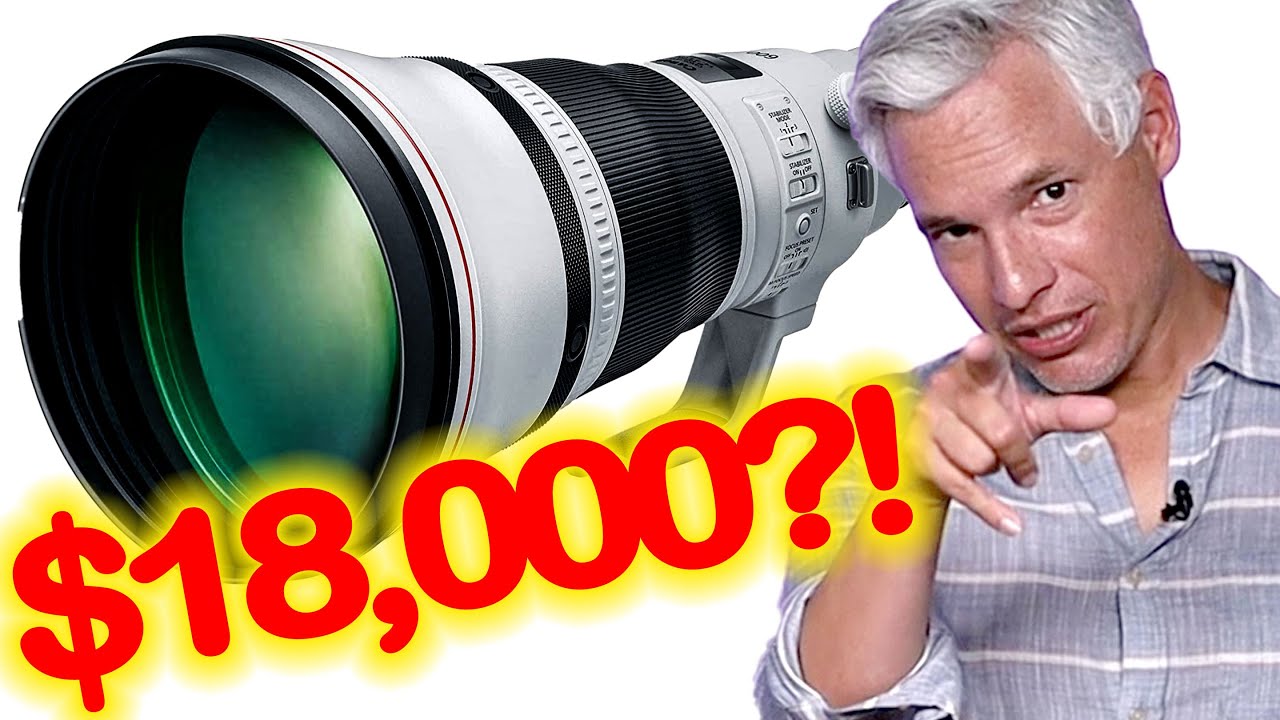
I spend a lot of time watching people get excited about specs they don’t fully understand. That’s not a knock — I’ve done it too. I once nearly bought a lens because it had a lower f-number than my current one, without stopping to think about the crop factor math that would make them functionally identical. So when Tony and Chelsea Northrup dropped a breakdown of the incoming Fujifilm 50mm f/1.0, Nikon 50mm f/1.2, and a handful of other new lenses, I watched it twice. Not because I’m rushing out to buy any of them, but because the way Tony frames the equivalency argument is exactly the kind of clear thinking that saves you from spending money badly.
Watch the full tutorial on YouTube
This is one of those tutorials that matters even if you’re not in the market for a $1,500 prime. Understanding how aperture, crop factor, and system design interact will affect every lens decision you make going forward. Here’s how Tony breaks it down, and where I think it gets even more interesting.
Step 1: Understand What Fujifilm’s 50mm f/1.0 Actually Is
 Fujifilm 50mm f/1.0 lens introduced on screen
Fujifilm’s 50mm f/1.0 is finally shipping after what felt like an eternity of anticipation. Tony frames it correctly from the start: this is a milestone for the X-mount system because it gives Fuji shooters access to a level of background separation that simply wasn’t available before on that platform. The lens lands at $1,500, and for Fuji loyalists who’ve been managing with the 56mm f/1.2, that’s a meaningful upgrade in terms of both bokeh potential and autofocus performance.
Fujifilm 50mm f/1.0 lens introduced on screen
Fujifilm’s 50mm f/1.0 is finally shipping after what felt like an eternity of anticipation. Tony frames it correctly from the start: this is a milestone for the X-mount system because it gives Fuji shooters access to a level of background separation that simply wasn’t available before on that platform. The lens lands at $1,500, and for Fuji loyalists who’ve been managing with the 56mm f/1.2, that’s a meaningful upgrade in terms of both bokeh potential and autofocus performance.
The focal length math puts it at roughly equivalent to a 75mm f/1.5 on full frame. That sits between a standard 50mm and a classic 85mm portrait lens, which makes it a slightly unusual choice by traditional standards. But Tony points out that smartphone portrait modes have shifted what people consider a “normal” portrait focal length closer to 40mm, so a 75mm equivalent may actually feel more natural to a younger audience raised on phone cameras.
Step 2: Apply the Crop Factor Before Comparing Apertures Across Systems
 Comparison graphic showing APS-C vs full frame aperture equivalency
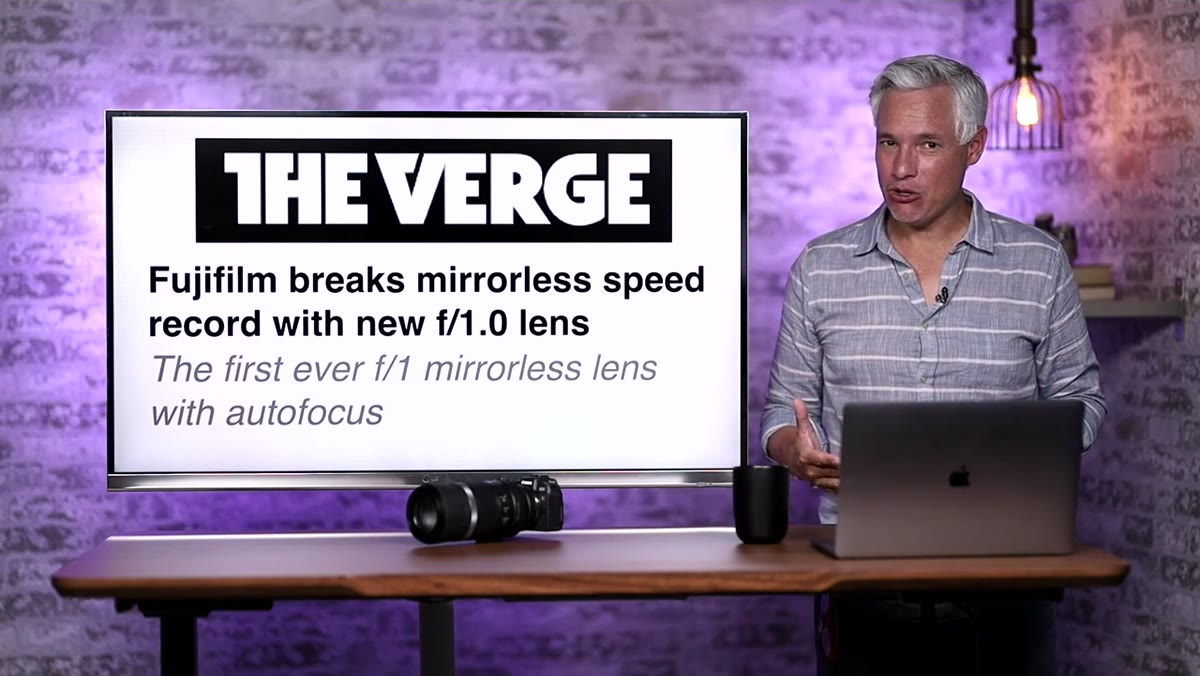
Here’s where Tony earns his keep. A lot of coverage around this lens called it the “fastest mirrorless lens ever,” and that framing is technically defensible but practically misleading. Tony uses a sharp analogy: claiming a fastest zero-to-60 record by measuring in kilometers per hour instead of miles per hour doesn’t make the car faster. Changing units doesn’t change physics.
Comparison graphic showing APS-C vs full frame aperture equivalency
Here’s where Tony earns his keep. A lot of coverage around this lens called it the “fastest mirrorless lens ever,” and that framing is technically defensible but practically misleading. Tony uses a sharp analogy: claiming a fastest zero-to-60 record by measuring in kilometers per hour instead of miles per hour doesn’t make the car faster. Changing units doesn’t change physics.
The rule is straightforward. Take the f-number and multiply it by the crop factor, which for Fuji’s APS-C sensors is 1.5. So f/1.0 on APS-C gives you the equivalent light-gathering and depth-of-field characteristics of about f/1.5 on full frame. That’s still excellent. But it’s not the same as a full-frame f/1.0. If you’re comparing lenses across systems, always do this multiplication before drawing conclusions. Your wallet will thank you.
Step 3: Factor in What Speed Boosters Already Offer Fuji Shooters
 Tony discussing speed booster setup on Fuji XT3
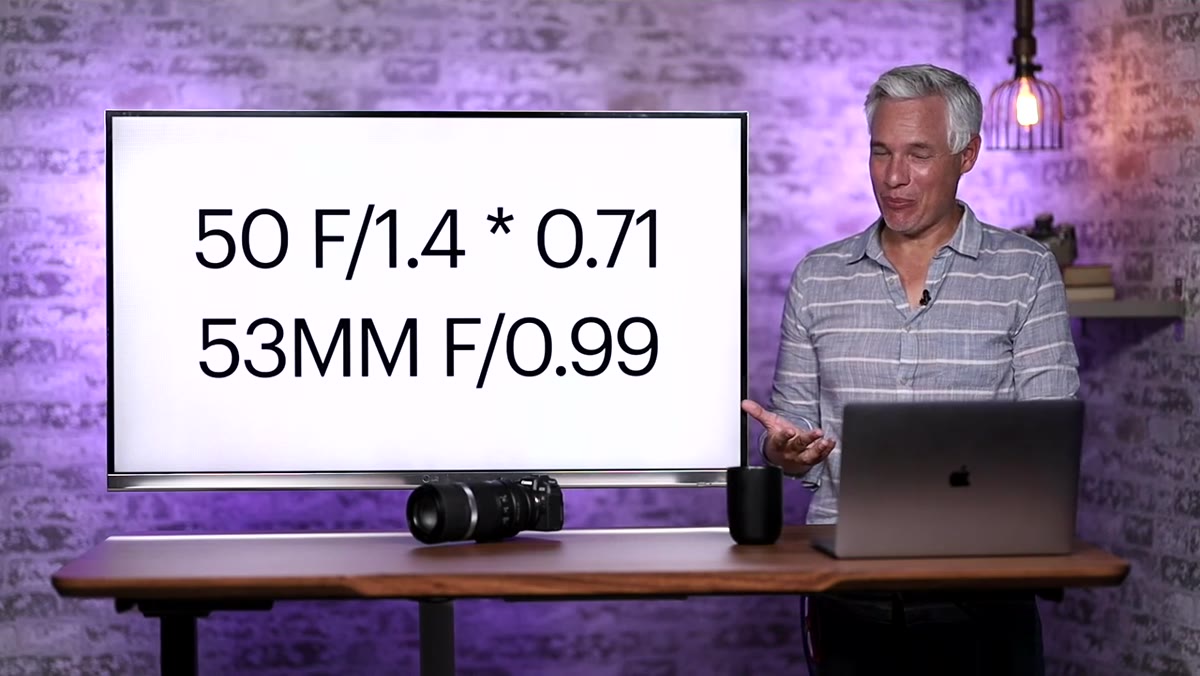
Tony makes a point here that I found genuinely useful. He’s been running a speed booster on his X-T3 and X-S10 with a Canon 50mm f/1.4, and the resulting combination works out to roughly 53mm at f/0.99 in APS-C terms. In other words, some shooters have already been operating near f/1.0 equivalent territory using adapted glass and a focal reducer.
Tony discussing speed booster setup on Fuji XT3
Tony makes a point here that I found genuinely useful. He’s been running a speed booster on his X-T3 and X-S10 with a Canon 50mm f/1.4, and the resulting combination works out to roughly 53mm at f/0.99 in APS-C terms. In other words, some shooters have already been operating near f/1.0 equivalent territory using adapted glass and a focal reducer.
This doesn’t make the new Fuji lens pointless. Native lenses will always win on autofocus reliability and system integration, and Tony specifically mentions that his 56mm f/1.2 struggles with focus during video. But it does mean the bar the new lens has to clear isn’t just “fast aperture” in isolation. It has to justify the cost over a capable adapted setup. If you’re already in a speed booster workflow and it’s working for you, this lens needs to deliver meaningfully better autofocus before it makes financial sense to switch.
Step 4: Evaluate the Nikon 50mm f/1.2 Against the Full-Frame Standard
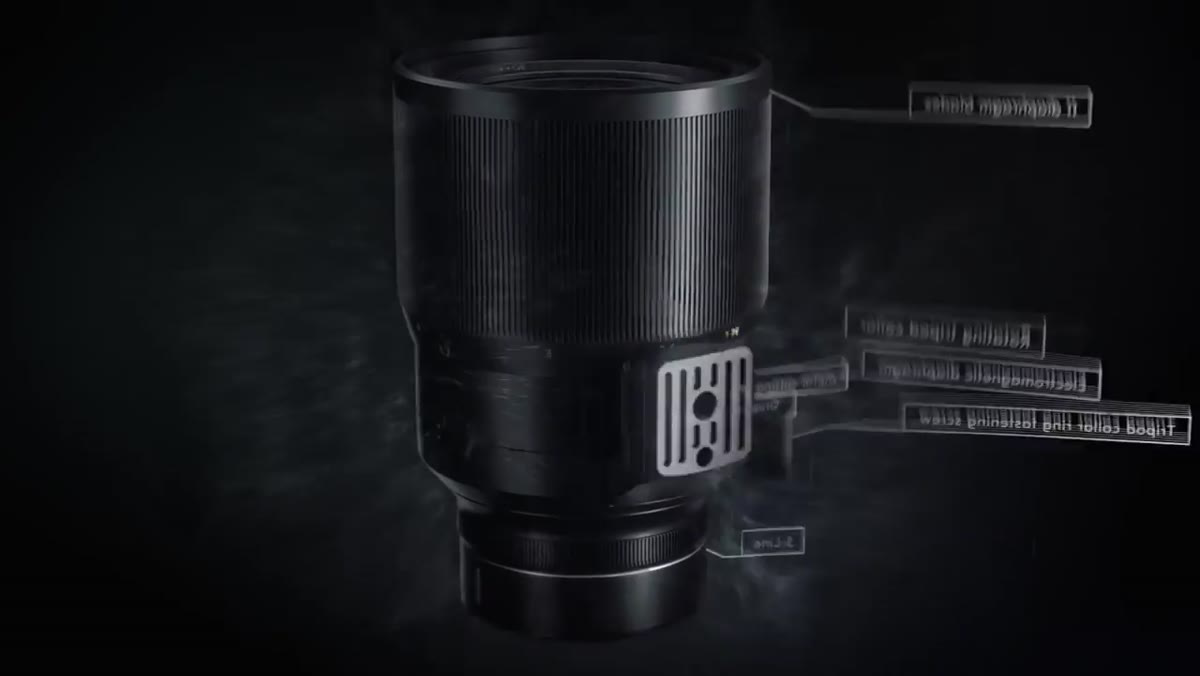
 Nikon Z 50mm f/1.2 announcement details shown
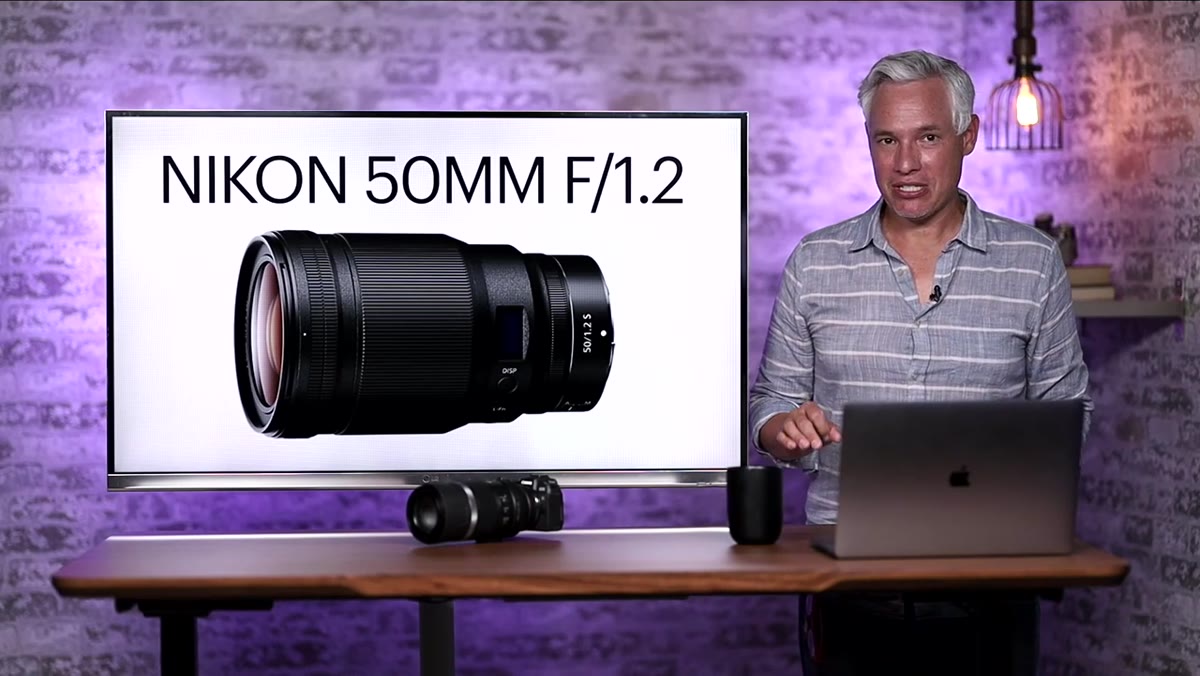
Nikon’s entry into this conversation is the Z-mount 50mm f/1.2, and because it’s designed for a full-frame sensor, the crop factor conversation disappears. What you see is what you get. An f/1.2 aperture on full frame gathers more total light and produces more background blur than the Fuji f/1.0 does in practice, despite the higher f-number. That surprises people, but the math is the math.
Nikon Z 50mm f/1.2 announcement details shown
Nikon’s entry into this conversation is the Z-mount 50mm f/1.2, and because it’s designed for a full-frame sensor, the crop factor conversation disappears. What you see is what you get. An f/1.2 aperture on full frame gathers more total light and produces more background blur than the Fuji f/1.0 does in practice, despite the higher f-number. That surprises people, but the math is the math.
Tony notes that Nikon’s Z system launch in 2018 was built around a wide-mount design that would eventually support faster, higher-quality glass than older SLR mounts could accommodate. This 50mm f/1.2 feels like a payoff on that original promise. It sits above the professional standard of f/1.4 without going to the exotic extremes of a Noctilux-style lens, which puts it in an interesting value tier for serious portrait and low-light work.
Step 5: Use Equivalency Math as a Buying Filter, Not Just a Spec Comparison
 Tony walking through aperture equivalency math on screen
Tony’s broader point, woven throughout the video, is that equivalency math is a decision-making tool. When you’re choosing between a Fuji system and a full-frame system, you’re not just comparing sensor size. You’re comparing the total cost to reach a given capability level. An APS-C system might be lighter and cheaper as a body, but if reaching f/1.5 equivalent performance requires a $1,500 native prime, you need to compare that against what full-frame offers at a similar price point.
Tony walking through aperture equivalency math on screen
Tony’s broader point, woven throughout the video, is that equivalency math is a decision-making tool. When you’re choosing between a Fuji system and a full-frame system, you’re not just comparing sensor size. You’re comparing the total cost to reach a given capability level. An APS-C system might be lighter and cheaper as a body, but if reaching f/1.5 equivalent performance requires a $1,500 native prime, you need to compare that against what full-frame offers at a similar price point.
Run the numbers in both directions. What does it cost to get to 75mm f/1.5 equivalent on Fuji versus Nikon versus Canon? What does that buy you in autofocus speed, weather sealing, and image quality? This is the spreadsheet I actually keep, and it’s changed my opinion on “budget-friendly” crop sensor systems more than once.
My Take: The Equivalency Gap Matters More When You’re Buying Used
I don’t have a horse in the race for any of these specific lenses. At my price point, I’m shopping used markets and watching for deals on previous-generation glass. But the equivalency lesson from this video has a direct application there too.
Used full-frame lenses from the SLR era are astonishingly cheap right now, especially Canon EF and Nikon F glass. A used Canon 50mm f/1.4 with a speed booster on a Fuji body can get you to f/1.0 equivalent territory for a fraction of what the new native lens costs. The autofocus won’t be as reliable for video, as Tony acknowledges from his own experience. But for still portraits, it’s worth at least putting on the spreadsheet before committing to $1,500 of new glass.
The single most important idea in this video is one that applies far beyond these three lenses: never compare aperture numbers across different sensor sizes without doing the crop factor math first. It’s a simple multiplication step that most marketing materials skip entirely, and it’s responsible for more gear buyer’s remorse than almost any other misunderstanding in photography.
Watch the full tutorial on YouTube to hear Tony walk through all of this in his own words, including additional details on the Canon and wide-angle announcements that round out the lens landscape picture.
Comments (3)
I keep coming back to this article. It's that useful.
Never thought of approaching it this way. Really creative.
Applied this to my portfolio shots and the improvement is noticeable.
Leave a Comment