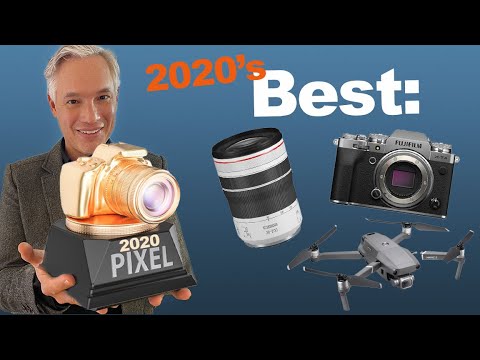
Every December I do the same thing: I pull up my gear spreadsheet, look at what I actually used that year, and try to figure out if I spent my money well. Most “best of the year” lists from big publications feel like they were written by a committee trying not to offend anyone. That’s why when Tony and Chelsea Northrup drop their annual Pixel Awards, I pay attention. They test the gear themselves, take no sponsorships from camera or lens manufacturers, and have burned bridges with enough companies to prove they’re not playing favorites.
Watch the full tutorial on YouTube
In this Tony and Chelsea Northrup video, the two of them run through their picks for the best smartphone camera, ultimate camera, drone, lens, computer, and even hand out a “disappointment of the year” and a “WTF price of the year.” For someone like me who tracks deals obsessively and writes about gear all day, this kind of opinionated, unsponsored breakdown is genuinely useful reference material. Here’s how to actually use their framework to make smarter buying decisions.
Step 1: Understand Why Unsponsored Reviews Change Everything
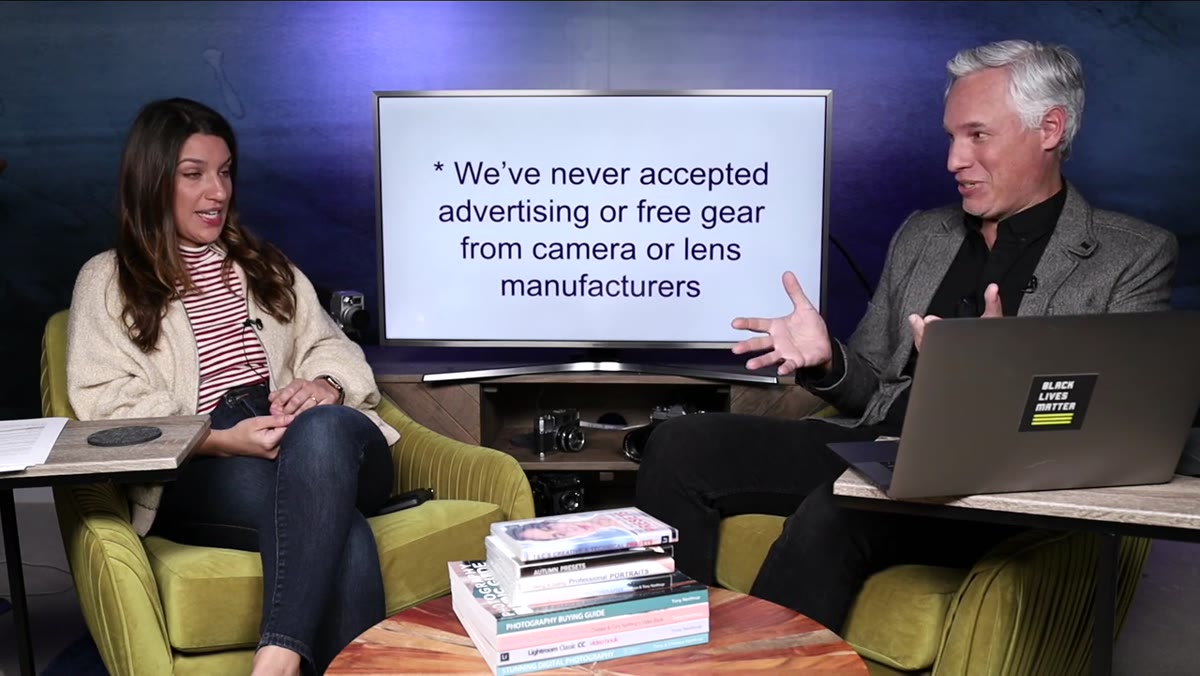
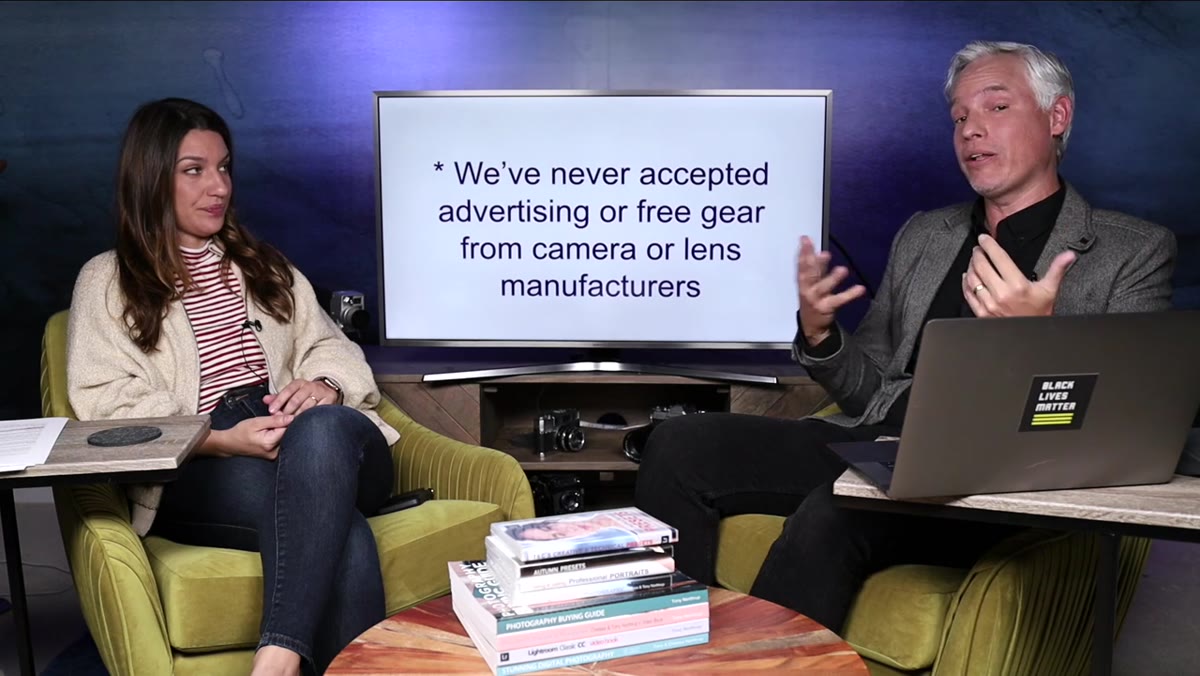 Tony explaining they test gear and take no manufacturer sponsorships
Tony makes a point early on that I think most viewers scroll past: they don’t accept sponsorships from camera or lens manufacturers. That’s not a small thing. When a reviewer is getting early access to gear, free loaner units, or paid placements, the incentive to hedge criticism is real even if it’s subconscious. Tony even jokes that he’s been “in timeout” with several companies for years because of honest reviews. That’s the credibility signal you want. When you’re reading any gear review, including mine, the first question should be: what does this person gain from recommending this product?
Tony explaining they test gear and take no manufacturer sponsorships
Tony makes a point early on that I think most viewers scroll past: they don’t accept sponsorships from camera or lens manufacturers. That’s not a small thing. When a reviewer is getting early access to gear, free loaner units, or paid placements, the incentive to hedge criticism is real even if it’s subconscious. Tony even jokes that he’s been “in timeout” with several companies for years because of honest reviews. That’s the credibility signal you want. When you’re reading any gear review, including mine, the first question should be: what does this person gain from recommending this product?
Step 2: Use the Smartphone Runner-Up to Benchmark Your Expectations
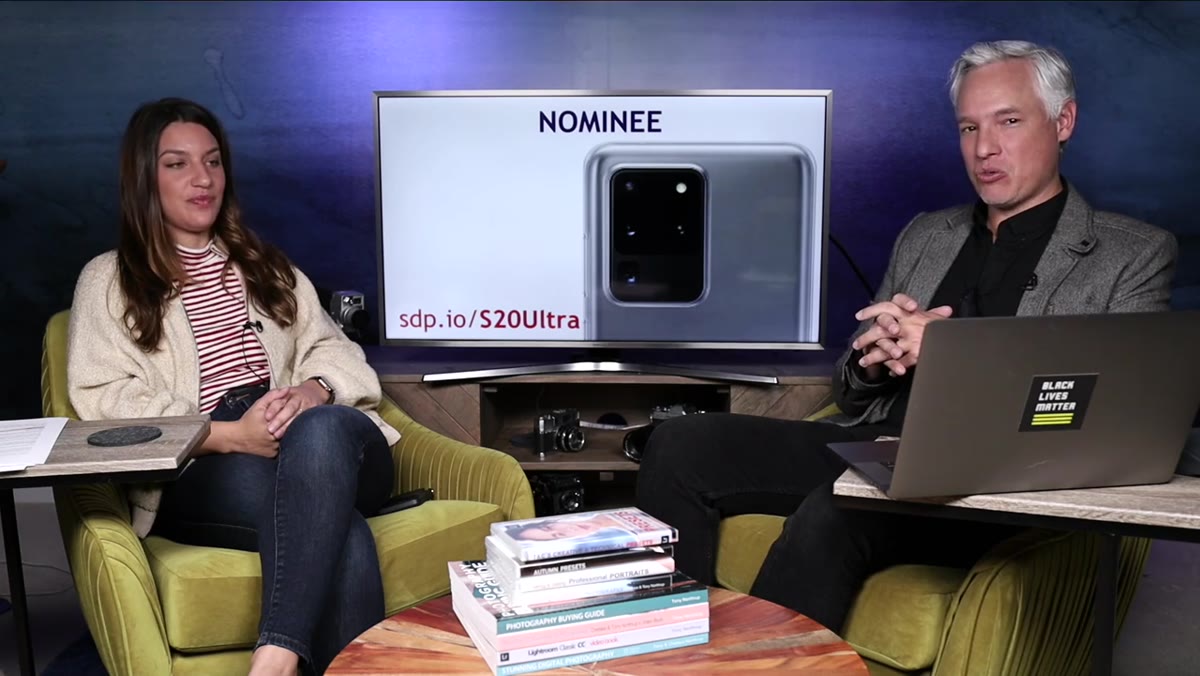 Samsung S20 Ultra shown as runner-up smartphone camera of the year
The runner-up for smartphone camera of the year was the Samsung S20 Ultra. Tony’s take is instructive: the 100-megapixel sensor sounds incredible on paper, but real-world testing showed it didn’t resolve as much detail as the spec sheet implied. The more interesting data point is that it still beat a full-frame Canon RP in several shooting scenarios. That should recalibrate how you think about the camera hierarchy in 2020. A phone with aggressive computational processing is competing with interchangeable-lens cameras. If you’re still telling people they need a dedicated camera to get “real” quality, this is the year that argument got complicated.
Samsung S20 Ultra shown as runner-up smartphone camera of the year
The runner-up for smartphone camera of the year was the Samsung S20 Ultra. Tony’s take is instructive: the 100-megapixel sensor sounds incredible on paper, but real-world testing showed it didn’t resolve as much detail as the spec sheet implied. The more interesting data point is that it still beat a full-frame Canon RP in several shooting scenarios. That should recalibrate how you think about the camera hierarchy in 2020. A phone with aggressive computational processing is competing with interchangeable-lens cameras. If you’re still telling people they need a dedicated camera to get “real” quality, this is the year that argument got complicated.
Step 3: Dig Into Why the Smartphone Winner Actually Won
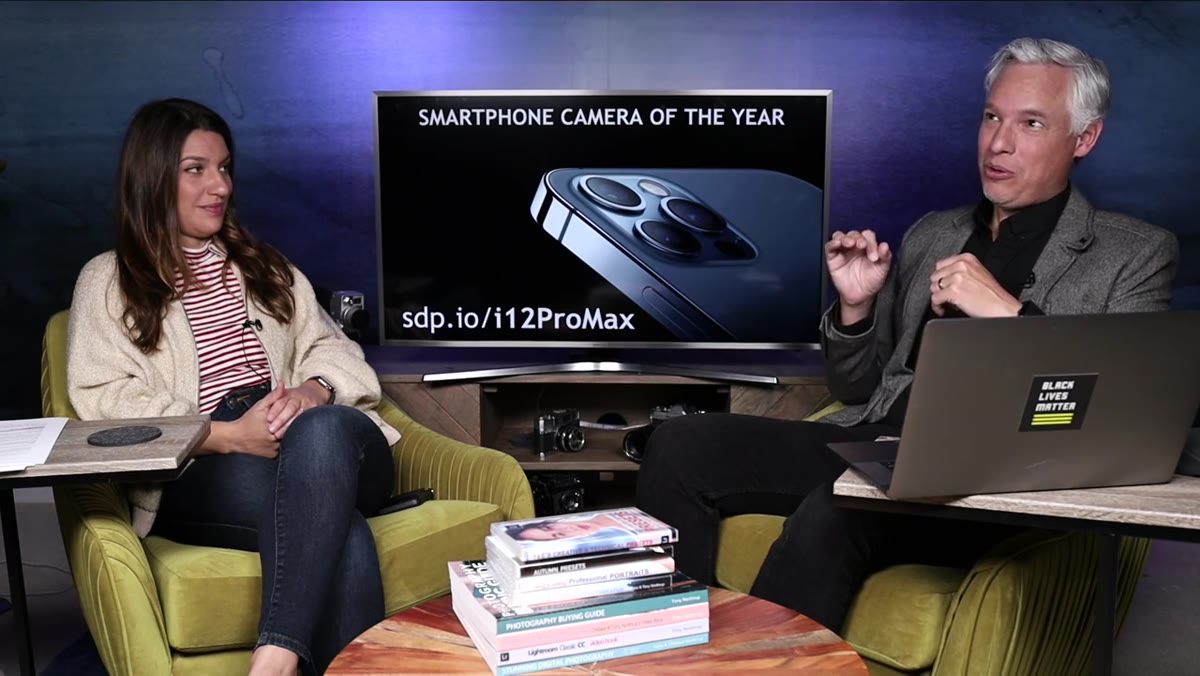 iPhone 12 Pro Max announced as smartphone camera of the year
The iPhone 12 Pro Max took the top spot, and the reasoning matters more than the trophy. Chelsea’s focus was on the Night mode performance specifically for astrophotography. Handheld, at night, the camera was pulling in more visible stars than her own eye could see, and in some cases more than a full-frame camera on a tripod. That’s computational photography doing work that optics alone can’t. The practical lesson here: when evaluating any smartphone camera in 2020 and beyond, Night mode performance and multi-frame processing are the specs that actually determine real-world usefulness. Megapixel count is a distraction.
iPhone 12 Pro Max announced as smartphone camera of the year
The iPhone 12 Pro Max took the top spot, and the reasoning matters more than the trophy. Chelsea’s focus was on the Night mode performance specifically for astrophotography. Handheld, at night, the camera was pulling in more visible stars than her own eye could see, and in some cases more than a full-frame camera on a tripod. That’s computational photography doing work that optics alone can’t. The practical lesson here: when evaluating any smartphone camera in 2020 and beyond, Night mode performance and multi-frame processing are the specs that actually determine real-world usefulness. Megapixel count is a distraction.
Step 4: Watch How They Handle the Vaporware Category
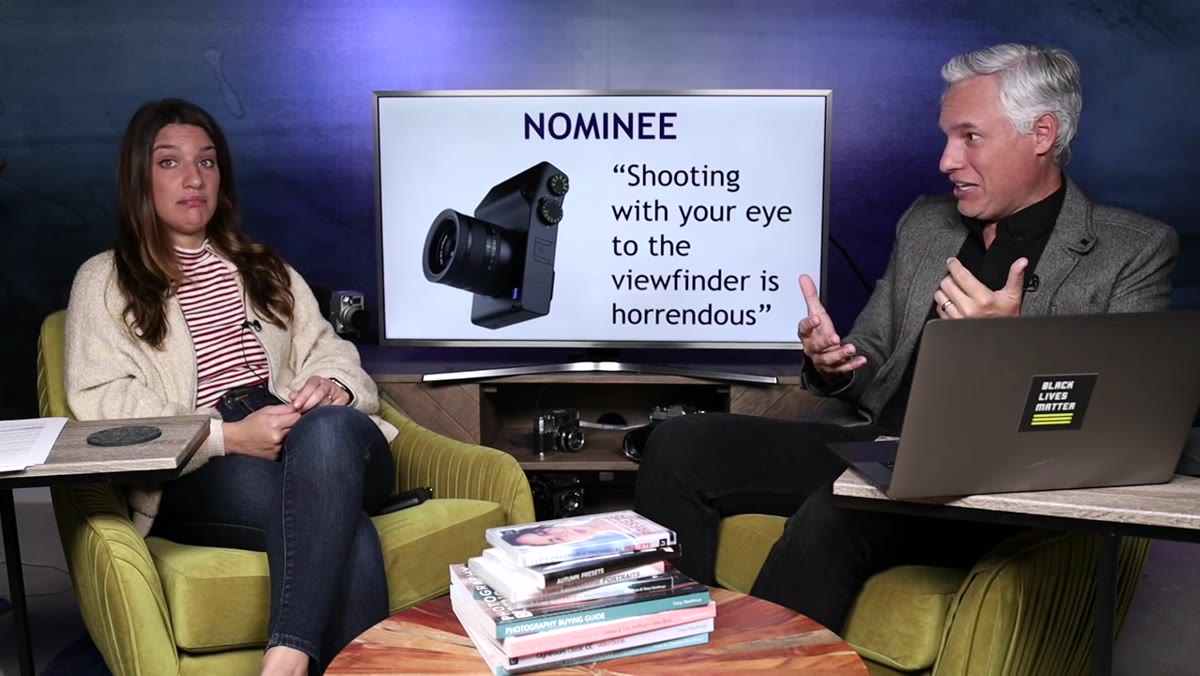
 Zeiss ZX1 discussed as vaporware award candidate
The vaporware category is where I think Tony and Chelsea’s format is most useful for deal hunters. Vaporware, in their definition, is gear that was announced and hyped but never actually shipped to real customers. The Zeiss ZX1 had been their repeat offender: a fixed-lens camera with full Lightroom built in and an Android operating system, announced and then… nothing for years. It barely escaped the 2020 award because units started shipping in the final weeks of the year. The lesson for buyers is blunt: never pre-order or budget for gear that doesn’t have confirmed, shipping inventory. Hype cycles in the camera industry are long and frequently disappointing.
Zeiss ZX1 discussed as vaporware award candidate
The vaporware category is where I think Tony and Chelsea’s format is most useful for deal hunters. Vaporware, in their definition, is gear that was announced and hyped but never actually shipped to real customers. The Zeiss ZX1 had been their repeat offender: a fixed-lens camera with full Lightroom built in and an Android operating system, announced and then… nothing for years. It barely escaped the 2020 award because units started shipping in the final weeks of the year. The lesson for buyers is blunt: never pre-order or budget for gear that doesn’t have confirmed, shipping inventory. Hype cycles in the camera industry are long and frequently disappointing.
Step 5: Apply the “Disappointment of the Year” Framework to Any Purchase
 Tony noting they are brutally honest and some picks are big flops
The disappointment category is arguably more useful than the winners list. A product can disappoint not because it’s bad in absolute terms, but because it failed to deliver on its specific promise or value proposition. That framing is something I try to bring to every budget review I write. The question isn’t “is this product acceptable?” It’s “did it do what it claimed to do, for the price it asked?” A $200 lens that performs like a $200 lens isn’t a disappointment. A $1,500 lens that performs like a $200 lens very much is. When Tony and Chelsea name a disappointment of the year, they’re essentially flagging where marketing outpaced reality.
Tony noting they are brutally honest and some picks are big flops
The disappointment category is arguably more useful than the winners list. A product can disappoint not because it’s bad in absolute terms, but because it failed to deliver on its specific promise or value proposition. That framing is something I try to bring to every budget review I write. The question isn’t “is this product acceptable?” It’s “did it do what it claimed to do, for the price it asked?” A $200 lens that performs like a $200 lens isn’t a disappointment. A $1,500 lens that performs like a $200 lens very much is. When Tony and Chelsea name a disappointment of the year, they’re essentially flagging where marketing outpaced reality.
Step 6: Use the WTF Price Award as a Market Sanity Check
 Tony previewing the WTF price of the year category
The “WTF price of the year” category is the most entertaining part of the video, but it also has a practical application. Every year there are products that get priced in ways that make no sense relative to the competition. Identifying those outliers helps you spot where a manufacturer is betting on brand loyalty or marketing budget rather than value. If a product wins this category, the move is simple: wait six months. Prices on overpriced gear tend to correct faster than the industry admits, especially when real-world reviews start rolling in.
Tony previewing the WTF price of the year category
The “WTF price of the year” category is the most entertaining part of the video, but it also has a practical application. Every year there are products that get priced in ways that make no sense relative to the competition. Identifying those outliers helps you spot where a manufacturer is betting on brand loyalty or marketing budget rather than value. If a product wins this category, the move is simple: wait six months. Prices on overpriced gear tend to correct faster than the industry admits, especially when real-world reviews start rolling in.
Step 7: Cross-Reference Against Your Actual Shooting Needs
 Tony and Chelsea discussing how gear decisions connect to real-world use
The final move with any “best of year” list is the most important and the most skipped. None of these awards tell you what gear is right for you specifically. The iPhone 12 Pro Max winning smartphone of the year means nothing if you’re a wedding photographer who needs a second body with a 200mm lens. The useful exercise is to map each winner against your actual shooting scenarios: the lighting you work in, the subjects you shoot, the output size you need. I keep a column in my gear spreadsheet for “use case match” so I can immediately filter out gear that’s impressive but irrelevant to what I actually do.
Tony and Chelsea discussing how gear decisions connect to real-world use
The final move with any “best of year” list is the most important and the most skipped. None of these awards tell you what gear is right for you specifically. The iPhone 12 Pro Max winning smartphone of the year means nothing if you’re a wedding photographer who needs a second body with a 200mm lens. The useful exercise is to map each winner against your actual shooting scenarios: the lighting you work in, the subjects you shoot, the output size you need. I keep a column in my gear spreadsheet for “use case match” so I can immediately filter out gear that’s impressive but irrelevant to what I actually do.
What I’d Add From the Budget Side
Tony and Chelsea test at a level where most of the gear discussed is mid-range to premium. That’s legitimate, because the best gear of the year should probably be evaluated without artificial price ceilings. But the computational photography story in the smartphone category is a strong argument for budget shooters: the gap between a flagship phone and a mid-range phone in 2020 narrowed faster than the gap between budget ILCs and premium ones. If your photography budget is tight, a current-generation mid-range Android with solid Night mode processing will outperform a used DSLR in more situations than most gear reviewers will tell you. I’ve run that test at meetups and the results are consistently humbling.
The single biggest takeaway from this video is one that Tony states almost as a throwaway: real-world testing beats spec sheets every time. A 100-megapixel sensor that doesn’t actually resolve detail is worse than a 12-megapixel sensor that does. That principle scales across every category in this video and every purchase decision you’ll make. Check the specs, then find someone who actually tested the thing.
Watch the full tutorial on YouTube
Comments (1)
I keep coming back to this article. It's that useful.
Leave a Comment