
There is a specific kind of paralysis that hits a lot of photographers I know, and honestly, it hit me hard in my early years. You keep telling yourself you will start sharing your work when the lens is sharper, when the editing is cleaner, when you finally understand light the way the pros do. I shot a wedding on a $300 kit that ended up in a local magazine, and even after that, I still caught myself hesitating to post street shots because the noise at ISO 3200 bothered me. The gear was never really the problem.
That is why this Mango Street video landed so differently than most photography motivation content. Watch the full tutorial on YouTube. Rachel and Daniel are not handing you a five-step formula for going viral. They are making a much more uncomfortable argument: that making art is not optional, that withholding your creative work does not protect you from criticism, it just keeps you stuck. As someone who has built a following by proving that a $500 camera can outperform a $2,000 one in the right hands, I think about the “right hands” part constantly. This video is about what shapes those hands.
Here is the core of what they teach, broken down into the actual moves you can take away from it.
Step 1: Reframe What “Creating” Actually Means
 Opening monologue about creation happening every day
Mango Street opens with a reframe that sounds simple but is genuinely disorienting if you sit with it. You are already creating, every single day. Not photographs necessarily, but mental states, habits, patterns. You create anxiety. You create avoidance. You create the story that you are not ready yet.
Opening monologue about creation happening every day
Mango Street opens with a reframe that sounds simple but is genuinely disorienting if you sit with it. You are already creating, every single day. Not photographs necessarily, but mental states, habits, patterns. You create anxiety. You create avoidance. You create the story that you are not ready yet.
The practical move here is to make that process conscious. Before you pick up your camera this week, ask yourself what you are actually producing with your time and attention. Are you creating skill, or are you creating reasons to wait? That question alone can shift how you approach a single afternoon of shooting.
Step 2: Reject the Idea That Art Is a Luxury You Have to Earn
 Discussion of art as rebellion and cultural power
The video makes a pointed argument that we have been conditioned to treat art as frivolous, especially anything that does not generate income. Mango Street pushes back hard on this. They point to Picasso’s Guernica, Dorothea Lange’s Depression-era documentary photographs, and protest music as examples of creative work that reshaped how entire generations understood power, suffering, and solidarity.
Discussion of art as rebellion and cultural power
The video makes a pointed argument that we have been conditioned to treat art as frivolous, especially anything that does not generate income. Mango Street pushes back hard on this. They point to Picasso’s Guernica, Dorothea Lange’s Depression-era documentary photographs, and protest music as examples of creative work that reshaped how entire generations understood power, suffering, and solidarity.
For photographers specifically, this matters because it redefines what “good” work is. A photograph does not have to be published, licensed, or admired by ten thousand people on Instagram to be doing something real. A portrait of your neighbor that makes them feel seen is doing something. A series of street photos that forces you to look at your own city differently is doing something. Stop waiting for external validation to tell you the work is worth making.
Step 3: Understand That Slowness and Care Are Themselves a Statement
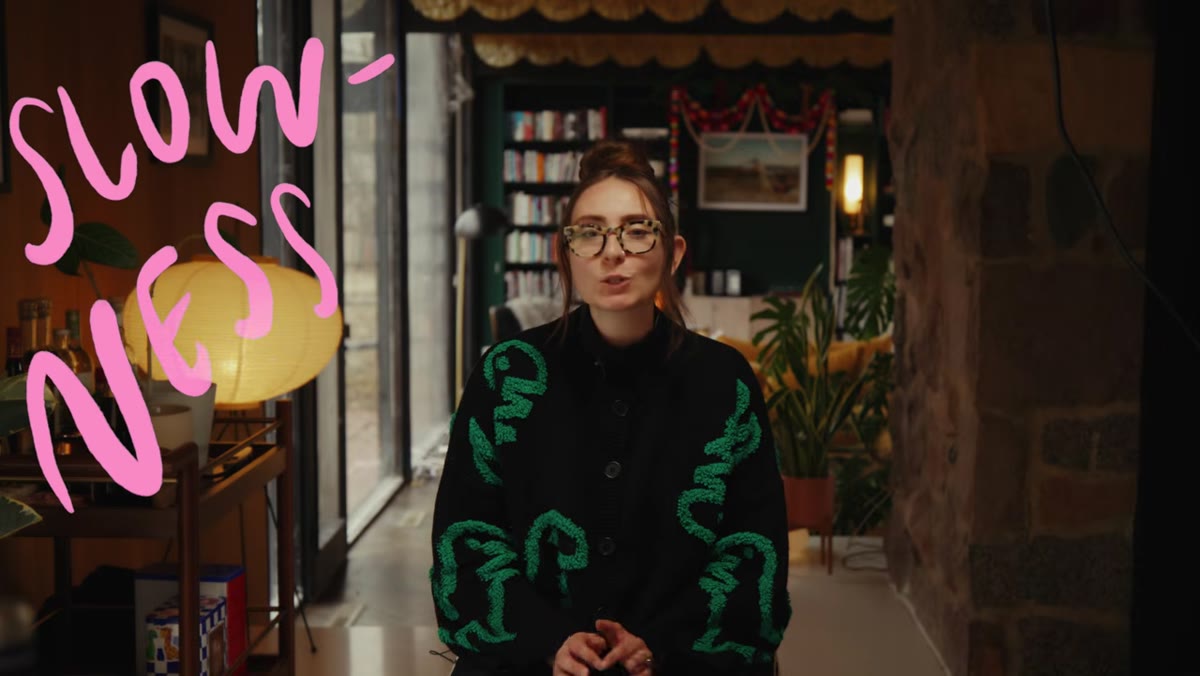 Craftivism and knitting as protest example
This is the section of the video that surprised me most. Mango Street brings up craftivism, the practice of using slow, deliberate handwork like knitting as a form of political protest. During Occupy Wall Street, people knit banners and installations specifically because the slow, careful nature of the work pushed back against productivity culture.
Craftivism and knitting as protest example
This is the section of the video that surprised me most. Mango Street brings up craftivism, the practice of using slow, deliberate handwork like knitting as a form of political protest. During Occupy Wall Street, people knit banners and installations specifically because the slow, careful nature of the work pushed back against productivity culture.
The photography application here is more direct than it looks. Shooting on a manual lens, spending an hour on a single composition, printing your work and putting it in a physical frame instead of just posting a JPEG: these are acts of care that resist the pressure to produce content at speed. Slow photography is not inefficiency. It is a different relationship with the work, and that relationship tends to produce images with more intention behind them.
Step 4: Make the Thing Even If It Feels Small
 Encouragement to create anything, regardless of perceived value
The video explicitly gives you permission to make something that is not earthshattering. Coloring books, fan fiction, a photo series that three people see. The point is not the audience size. The point is that engaging with a creative act you love builds a relationship with your own imagination that compounds over time.
Encouragement to create anything, regardless of perceived value
The video explicitly gives you permission to make something that is not earthshattering. Coloring books, fan fiction, a photo series that three people see. The point is not the audience size. The point is that engaging with a creative act you love builds a relationship with your own imagination that compounds over time.
For budget photographers especially, this is worth hearing. You do not need to be shooting editorial work to be developing your eye. The photographers I have seen improve fastest are almost never the ones waiting for big assignments. They are the ones shooting the same park every week until they know exactly how the light behaves at 7am in October.
Step 5: Share the Work Even When It Feels Incomplete
 Direct call to share creative work publicly
Mango Street ends with a direct challenge: make something this month, and then share it. Not when it is perfect. Now. Their reasoning is that someone out there is waiting to feel less alone, and your imperfect, real work is exactly what connects people. That is not motivational poster language. That is how parasocial creative communities actually function.
Direct call to share creative work publicly
Mango Street ends with a direct challenge: make something this month, and then share it. Not when it is perfect. Now. Their reasoning is that someone out there is waiting to feel less alone, and your imperfect, real work is exactly what connects people. That is not motivational poster language. That is how parasocial creative communities actually function.
The practical step is to set a specific, small deadline. Not “I will share more work eventually.” Pick a date, pick a platform, and put up one image or one series before that date. The share itself is the skill you are building, separate from the photography skill. You have to practice both.
What I Would Add: The Gear Anxiety Version of This Problem
I want to name something the video does not address directly, because it is the version I see most often in photography communities. A lot of photographers are not withholding their work because they doubt their creativity. They are withholding it because they believe the gear is the missing variable. If they had the f/1.4 prime instead of the f/1.8, if they had the full-frame body instead of the crop sensor, then the work would be worth sharing.
I have run blind comparisons at local meetups where nobody could distinguish shots from a $500 camera body versus a $2,000 one when the images were printed at normal sizes. Gear matters at the margins. Intention and practice matter everywhere else. The Mango Street argument is really about permission, and I would add: do not let an equipment wish list become the thing you hide behind. The $300 kit you already own is enough to make something real.
The single most important thing this video teaches is that creative work is not a reward for being ready. It is how you become ready. Make something imperfect and put it out there. That is the whole practice.
Watch the full tutorial on YouTube and let Mango Street make the case in their own words. It is worth the four minutes.
Comments
Leave a Comment