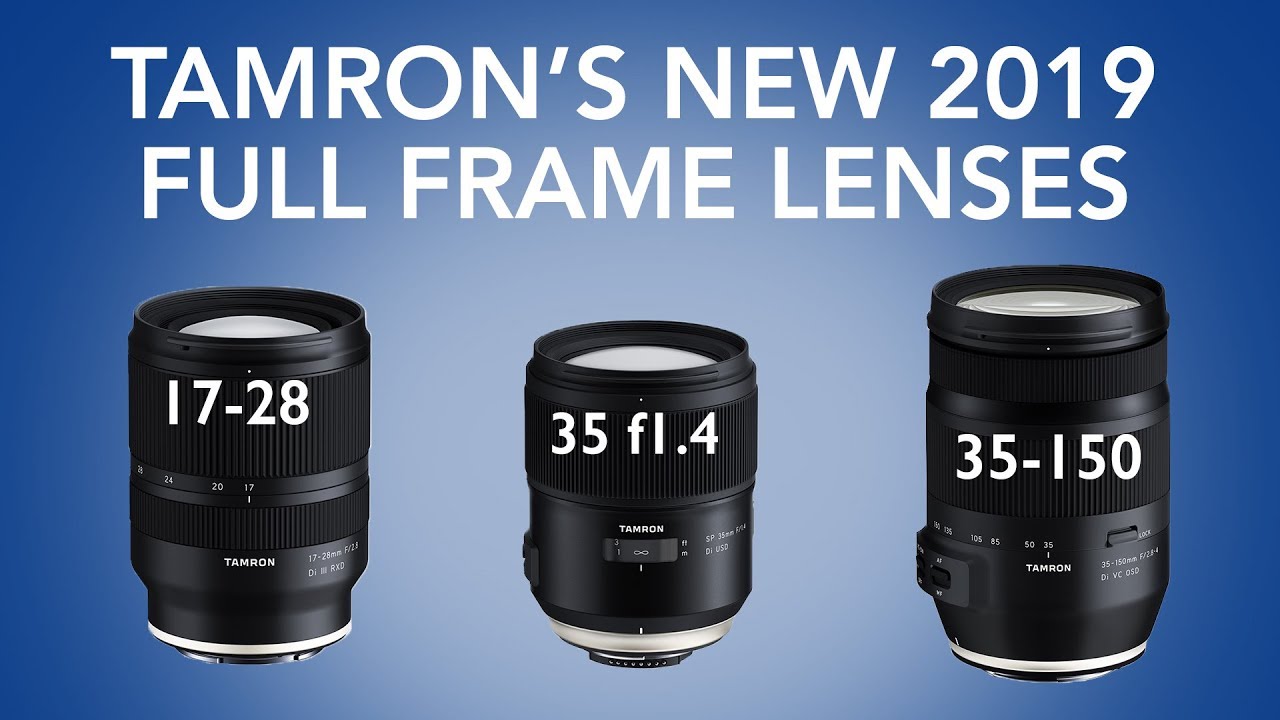
Every January I tell myself I’m done chasing gear announcements. Then something like this happens. Tamron quietly dropped details on three new lenses for 2019, and honestly, they’re the kind of announcements that actually move the needle for shooters like me who track value obsessively. I’ve got a spreadsheet with every third-party lens I’ve tested in the last three years, and Tamron keeps showing up near the top for image quality per dollar. So when I caught this breakdown from JP Morgan and Kenneth Merl over at The Slanted Lens, I took notes. Watch the full tutorial on YouTube
What grabbed me wasn’t just the specs. It was the pattern. Tamron is doing something smart with focal lengths and aperture ranges that lets them build smaller, lighter, more affordable glass without completely sacrificing what photographers actually need. That’s a design philosophy I can get behind. Here’s what they announced and why each one matters.
Step 1: Understand the 35-150mm f/2.8-4 Concept
 JP introducing the 35-150mm lens on screen
This is the lens that surprised me most. A 35-150mm range sounds odd at first, but when you think about it, Tamron is essentially packaging a landscape-capable wide end with a deep portrait range in a single zoom. The aperture opens at f/2.8 on the 35mm end and narrows to f/4 at 150mm. That trade-off is deliberate. Keeping the aperture variable lets Tamron build the lens smaller and cheaper than a constant f/2.8 version would be, and f/4 at 150mm is still genuinely useful for portraits.
JP introducing the 35-150mm lens on screen
This is the lens that surprised me most. A 35-150mm range sounds odd at first, but when you think about it, Tamron is essentially packaging a landscape-capable wide end with a deep portrait range in a single zoom. The aperture opens at f/2.8 on the 35mm end and narrows to f/4 at 150mm. That trade-off is deliberate. Keeping the aperture variable lets Tamron build the lens smaller and cheaper than a constant f/2.8 version would be, and f/4 at 150mm is still genuinely useful for portraits.
The appeal here is versatility. If you’re a travel photographer or a one-bag shooter, this covers ground that normally requires two or three primes. You’ve got the wide end for environmental shots, a natural 85mm equivalent sitting right in the middle of the range for flattering portraits, and that tight 150mm end for compressed backgrounds. The 24-70 and 24-105 zooms that dominate the market stop well short of that portrait sweet spot.
Step 2: Pay Attention to the Minimum Focusing Distance
 Hosts discussing the 17.7-inch minimum focus distance
One spec that gets buried in announcements but matters a lot in practice: the 35-150mm has a minimum focusing distance of just 17.7 inches. If the lens itself is roughly 7 inches long, you’re talking about getting the front of the glass about 10 inches from your subject at the close end. At 150mm, that’s approaching macro territory. A foot and a half from your subject at 150mm gives you serious subject separation and a level of detail that opens up product work, food photography, or tight environmental portraits without carrying a dedicated macro lens.
Hosts discussing the 17.7-inch minimum focus distance
One spec that gets buried in announcements but matters a lot in practice: the 35-150mm has a minimum focusing distance of just 17.7 inches. If the lens itself is roughly 7 inches long, you’re talking about getting the front of the glass about 10 inches from your subject at the close end. At 150mm, that’s approaching macro territory. A foot and a half from your subject at 150mm gives you serious subject separation and a level of detail that opens up product work, food photography, or tight environmental portraits without carrying a dedicated macro lens.
For budget shooters doing versatile commercial work, that spec alone could justify the purchase. Keep it in mind when the price is eventually announced.
Step 3: Evaluate the 35mm f/1.4 as a Prime Upgrade
 Hosts discussing the 35mm f/1.4 prime announcement
Tamron already had a 35mm f/1.8 in their lineup. This new f/1.4 version is a meaningful step up, not just a marketing revision. That full stop of extra light matters in low-light event shooting, for gimbal work where you want the fastest shutter speed you can get, and for the extra subject separation a wider aperture produces. The 35mm focal length is one I keep coming back to because it sits in a comfortable middle ground, not so wide that you get distorted faces in closer portraits, and not so tight that you lose the environmental context around your subject.
Hosts discussing the 35mm f/1.4 prime announcement
Tamron already had a 35mm f/1.8 in their lineup. This new f/1.4 version is a meaningful step up, not just a marketing revision. That full stop of extra light matters in low-light event shooting, for gimbal work where you want the fastest shutter speed you can get, and for the extra subject separation a wider aperture produces. The 35mm focal length is one I keep coming back to because it sits in a comfortable middle ground, not so wide that you get distorted faces in closer portraits, and not so tight that you lose the environmental context around your subject.
JP frames it almost as a second-generation product, even though Tamron isn’t calling it that officially. The existing 35mm f/1.8 was already a solid performer, so a faster version with the same general size and build quality could slot in as a genuinely competitive prime against Canon and Nikon’s own 35mm offerings, likely at a lower price point.
Step 4: Note the Use Cases for the 35mm f/1.4
 Hosts listing sports, journalism, and landscape use cases
The 35mm f/1.4 sits in a strange and useful category. It’s wide enough for photojournalism and street work. It’s fast enough for indoor sports or stage photography where you’re fighting mixed and dim lighting. And it’s compact enough, assuming Tamron keeps the physical size close to the f/1.8 version, to sit on a gimbal without throwing off balance. That last point matters if you’re doing any hybrid photo and video work, which most of us are doing more of now whether we planned on it or not.
Hosts listing sports, journalism, and landscape use cases
The 35mm f/1.4 sits in a strange and useful category. It’s wide enough for photojournalism and street work. It’s fast enough for indoor sports or stage photography where you’re fighting mixed and dim lighting. And it’s compact enough, assuming Tamron keeps the physical size close to the f/1.8 version, to sit on a gimbal without throwing off balance. That last point matters if you’re doing any hybrid photo and video work, which most of us are doing more of now whether we planned on it or not.
If I’m being direct: this is the kind of lens I’d put on my camera and forget to take off for two weeks. It’s that general-purpose useful.
Step 5: Understand Tamron’s First Sony E-Mount Mirrorless Lens
 Hosts introducing the new mirrorless lens announcement
Tamron’s first mirrorless offering, the 28-75mm f/2.8, was well-received. The Slanted Lens tested it and came away impressed specifically by its sharpness and compact size, which is a combination that doesn’t always come together at this price tier. The new mirrorless announcement appears to extend that same design philosophy, with matching physical dimensions and the same 67mm filter diameter, keeping it as a cohesive family of glass rather than a one-off product.
Hosts introducing the new mirrorless lens announcement
Tamron’s first mirrorless offering, the 28-75mm f/2.8, was well-received. The Slanted Lens tested it and came away impressed specifically by its sharpness and compact size, which is a combination that doesn’t always come together at this price tier. The new mirrorless announcement appears to extend that same design philosophy, with matching physical dimensions and the same 67mm filter diameter, keeping it as a cohesive family of glass rather than a one-off product.
The 28mm wide end is slightly narrower than the 35-150’s wide end, which makes this the better choice for architecture or tight interior shooting where you want a little more breathing room. For Sony shooters who’ve been waiting for Tamron to build out a real system of lenses, this second mirrorless entry signals that they’re committed to the platform. That matters when you’re deciding whether to invest in a brand’s ecosystem.
Step 6: Check for Chromatic Aberration Controls
 Hosts discussing Tamron’s low dispersion glass technology
Tamron is specifically highlighting their low dispersion glass on these new lenses, which is aimed at reducing chromatic aberration. This is an area where budget and third-party glass has historically let shooters down. Purple fringing and color bleeding along high-contrast edges are the kinds of flaws that show up most in post when you’re pushing a shot, and they’re annoying to correct manually across hundreds of frames. The fact that Tamron is calling this out directly tells me they’ve heard the feedback and are taking optical quality seriously as a competitive differentiator.
Hosts discussing Tamron’s low dispersion glass technology
Tamron is specifically highlighting their low dispersion glass on these new lenses, which is aimed at reducing chromatic aberration. This is an area where budget and third-party glass has historically let shooters down. Purple fringing and color bleeding along high-contrast edges are the kinds of flaws that show up most in post when you’re pushing a shot, and they’re annoying to correct manually across hundreds of frames. The fact that Tamron is calling this out directly tells me they’ve heard the feedback and are taking optical quality seriously as a competitive differentiator.
For working photographers who need consistency across a shoot rather than just impressive sample images, this kind of technical commitment matters more than raw resolution numbers.
My Take: Track the Price Before You Pre-Order
I’ll hold my full judgment until pricing drops. That’s always my policy. I’ve seen enough compelling lens announcements turn into mediocre value propositions once the MSRP hits. What I can say is that Tamron’s recent trajectory has been toward genuinely competitive products at prices that don’t require you to choose between buying glass and paying rent. The 35-150mm in particular is the kind of optically ambitious, practically designed lens that would go straight into my testing queue, and probably onto my own camera shortly after.
The real question for most of us isn’t whether these lenses are technically impressive. It’s whether the price-to-performance ratio holds up against what Canon, Nikon, and Sony are offering at the same focal lengths. Based on Tamron’s recent track record, I’m cautiously optimistic.
If you’re a full-frame shooter trying to simplify your kit without going back to entry-level image quality, these three lenses are worth watching. The 35-150mm zoom especially has the potential to replace a whole bag of glass for the right shooter.
Watch the full tutorial on YouTube and hear JP and Kenneth break down their initial reactions directly.
Comments
Leave a Comment