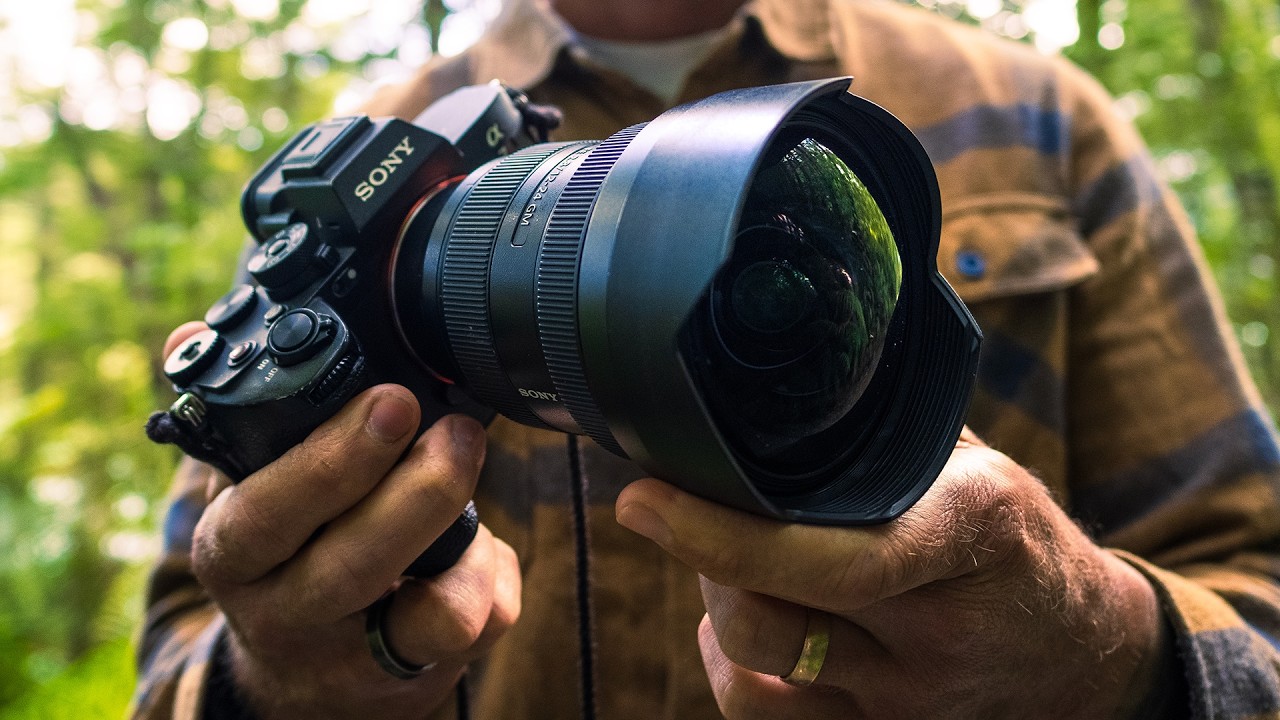
I have a spreadsheet. It has every lens I’ve tested in the last four years, sorted by price-per-usable-stop, sharpness at the edges, and whether the build quality held up past six months. I’m not bragging about that. I’m saying it because when I started seriously looking at ultra-wide options for Sony E-mount, I almost convinced myself the Sony 12-24mm f/2.8 belonged on it. Almost.
The honest problem I kept running into was this: at the extreme wide end, most budget alternatives fall apart. The distortion gets weird, edge sharpness collapses, and you’re spending more time in post correcting barrel distortion than actually editing. So I started taking a harder look at whether spending real money on the Sony flagship ultra-wide was actually justified, or whether the price tag was doing most of the persuading.
That’s what led me to this William Patino tutorial, which does something most gear reviews don’t. It skips the spec sheet celebration and gets into the honest trade-offs.
What You’re Actually Buying at 12mm f/2.8
The Sony 12-24mm f/2.8 is a constant aperture ultra-wide zoom, which sounds obvious but matters more than people acknowledge. Constant f/2.8 across a zoom range starting at 12mm means you’re getting serious low-light capability at focal lengths where most lenses are already asking you to compromise. Patino points out that this makes it genuinely useful for two very different shooting scenarios: astrophotography and architecture or real estate work, indoors with mixed or limited light.
At 12mm, you’re looking at an angle of view so wide that you need to think differently about composition. Foreground elements become massive, backgrounds compress in unexpected ways, and getting that aperture down to f/2.8 means you can pull in enough light to shoot the Milky Way while keeping a reasonable shutter speed and not torching your ISO.
The zoom range from 12-24mm also covers a span that a lot of photographers underestimate. At 24mm you’re in standard wide territory, useful for environmental portraits or tight interiors. At 12mm you’re doing something almost architectural in how much of a scene you can include. Having both in one lens without sacrificing aperture is genuinely useful, not just a marketing line.
The Weight and Size Problem Nobody Warns You About
Here’s where Patino gets honest in a way I appreciated. This lens is heavy. We’re talking about 847 grams, which on a Sony body that’s known for being compact starts to feel like the tail wagging the dog. If you’re hiking, shooting handheld for hours, or traveling with a minimal kit, this weight is a real daily consideration, not just a spec to scroll past.
The size also creates a practical issue that doesn’t show up in studio reviews: the front element is so dramatically curved that filters are basically not an option. There’s no thread on the front. You can use a rear gel filter slot for certain effects or exposure control, but if you rely on circular polarizers for landscape work, this lens takes that tool away from you. That’s worth knowing before you buy.
Patino frames this as a lens that rewards shooters who know exactly what they need it for. It isn’t a walk-around lens that happens to go wide. It’s a specialized tool that happens to cover a zoom range.
Optical Performance: Where the Price Starts to Make Sense
The sharpness story is strong. Patino walks through real-world results showing the lens holds up well at f/2.8 across most of the frame, which is genuinely hard to achieve at 12mm. Edge sharpness at wide apertures is where cheaper ultra-wide lenses get exposed, and the Sony earns its reputation here.
Autofocus is fast and quiet, which matters for video shooters who might be considering this for cinematic wide shots or documentary work. The optical stabilization integration with Sony bodies also works well, though at ultra-wide focal lengths you’re often less dependent on stabilization for stills anyway.
Distortion is well-controlled for a lens this wide, but it isn’t zero. Patino notes that Sony’s in-camera correction handles most of it automatically, which is fine for JPEG shooters but means RAW shooters need to confirm their editing software is applying the right profile. Lightroom and Capture One both handle this with the correct lens profile selected, but it’s a step you need to remember.
Where I’d Push Back: The Budget Alternative Worth Considering
If your shooting is primarily landscape or astrophotography and you’re not on a tight deadline, the Laowa 10mm f/2.8 prime is worth serious consideration. Patino actually links it in his video description. No autofocus and no zoom, but optically it competes at a fraction of the price, and for static subjects where you’re already on a tripod, manual focus at 10mm isn’t the limitation it sounds like.
I ran a comparison at a local photography meetup once where nobody could identify which shots came from a budget kit and which came from a premium setup. The ultra-wide category is where that kind of test gets most interesting, because the wide angle itself creates so much visual impact that viewers often attribute quality to the composition rather than the glass.
That doesn’t mean the Sony 12-24mm f/2.8 isn’t worth its price. It means it’s worth its price for the right shooter. If you’re doing professional event work, real estate, or need reliable autofocus in the dark, the premium is justified. If you’re a hobbyist shooting landscapes on weekends, the math probably doesn’t work in your favor.
The One Thing to Get Clear Before You Buy
Before spending $3,300 on this lens, get specific about whether you need the zoom range or whether a sharp, fast prime in the same focal length would serve you better for less money. The Sony 12-24mm f/2.8 is excellent. It’s also a lens that rewards shooters who have outgrown alternatives, not shooters who are excited about what it might unlock.
Watch the full William Patino video for the visual walkthrough and real-world sample shots that make these trade-offs concrete.
Comments
Leave a Comment