
Every time I put together a lens buying guide, someone in the comments asks some version of the same question: “Is the name-brand version actually worth the premium, or am I just paying for the logo?” With standard zooms, that question hits hardest in the 24-70 f/2.8 range, because these are working lenses. Photographers buy them to shoot weddings, events, portraits, travel – the stuff that actually pays or matters. The price gap between the Nikon and Tamron versions of this focal range sits around $600 at most price points, which is not rounding error money.
In this Tony and Chelsea Northrup tutorial (Watch the full tutorial on YouTube), they take both lenses to a real outdoor location and run them through a set of tests that actually mirror how these lenses get used – not just brick wall charts. Tony shoots into the sun, wide open, stopped down, and up close. What comes out of that session is nuanced enough to change how you think about the Tamron’s value proposition. Here is a step-by-step breakdown of what they tested and what it means for anyone on the fence.
Step 1: Test Flare and Contrast by Shooting Directly Into the Sun
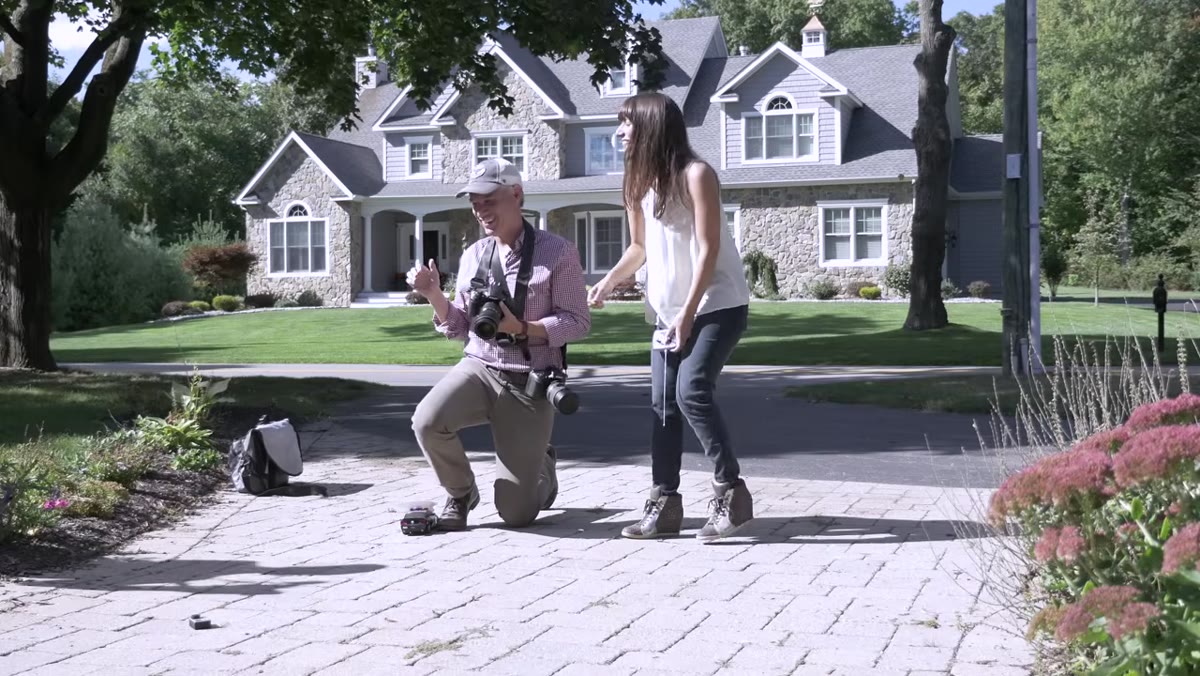
 Tony shooting toward sun with Chelsea in frame
Point either of these lenses directly at a bright light source and you will immediately learn something about its coating quality. Tony shoots with Chelsea backlit by direct sunlight, which is the fastest way to expose how well a lens suppresses flare and maintains contrast in high-dynamic-range situations. The Tamron shows a soft, hazy bloom in the lower portion of the frame that the Nikon does not reproduce. It is not catastrophic flare – nobody is going to ruin a shoot over it – but the Nikon holds contrast noticeably better when the sun is in or near your frame. If you shoot a lot of backlit portraits or outdoor ceremonies, this gap is real and worth accounting for.
Tony shooting toward sun with Chelsea in frame
Point either of these lenses directly at a bright light source and you will immediately learn something about its coating quality. Tony shoots with Chelsea backlit by direct sunlight, which is the fastest way to expose how well a lens suppresses flare and maintains contrast in high-dynamic-range situations. The Tamron shows a soft, hazy bloom in the lower portion of the frame that the Nikon does not reproduce. It is not catastrophic flare – nobody is going to ruin a shoot over it – but the Nikon holds contrast noticeably better when the sun is in or near your frame. If you shoot a lot of backlit portraits or outdoor ceremonies, this gap is real and worth accounting for.
Step 2: Compare Sharpness Wide Open at the Same Subject
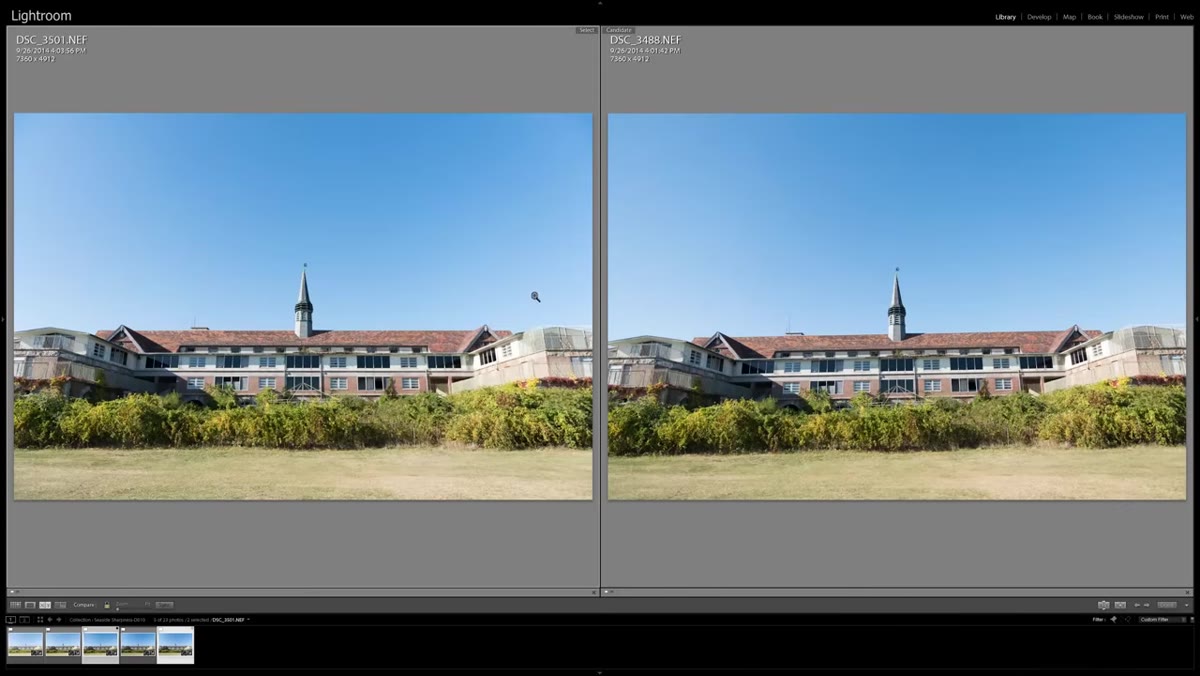 Side-by-side comparison of building shots, Nikon left, Tamron right
Tony shoots a building with architectural detail – shingles, specifically – at f/2.8 on both lenses mounted to a Nikon D810. He ran this test repeatedly to eliminate focusing luck as a variable. The result is counterintuitive: the Tamron is sharper wide open. Zoom into the shingle detail and the Nikon image goes soft in a way that is visible even before you pixel-peep. This matters for anyone using f/2.8 for subject separation in low light. If you are buying a fast zoom specifically to shoot wide open, the cheaper lens is actually delivering more of what you paid for.
Side-by-side comparison of building shots, Nikon left, Tamron right
Tony shoots a building with architectural detail – shingles, specifically – at f/2.8 on both lenses mounted to a Nikon D810. He ran this test repeatedly to eliminate focusing luck as a variable. The result is counterintuitive: the Tamron is sharper wide open. Zoom into the shingle detail and the Nikon image goes soft in a way that is visible even before you pixel-peep. This matters for anyone using f/2.8 for subject separation in low light. If you are buying a fast zoom specifically to shoot wide open, the cheaper lens is actually delivering more of what you paid for.
Step 3: Check Light Transmission Across Both Apertures
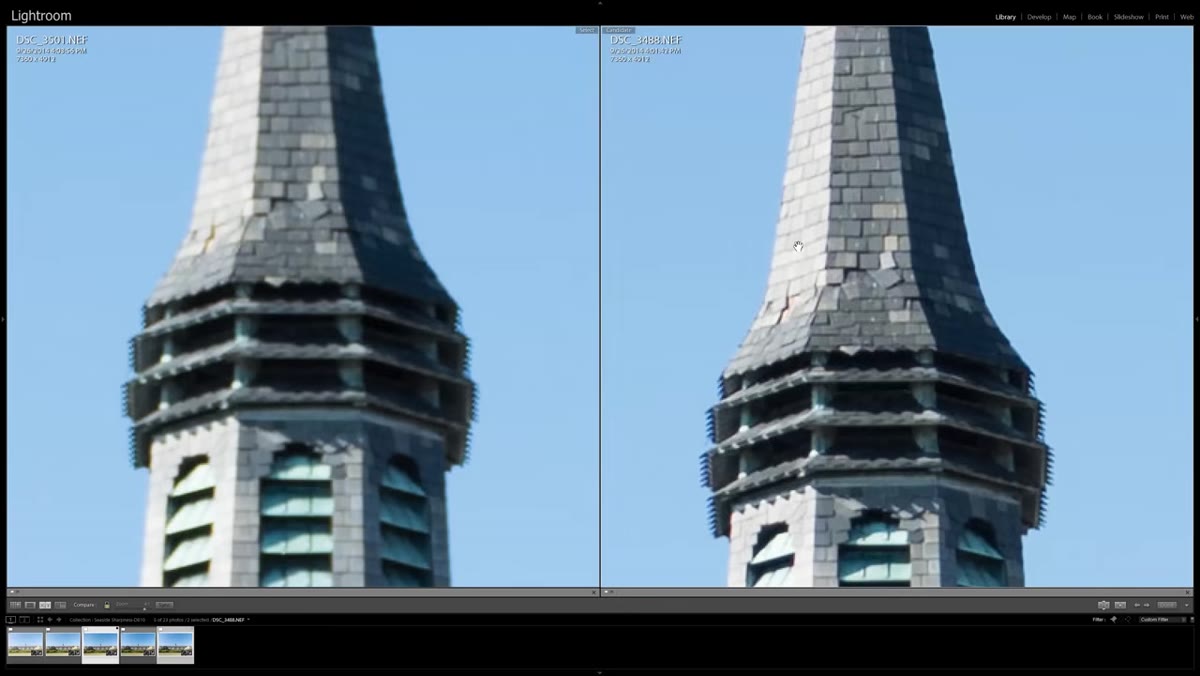 Wide-angle view showing Tamron image visibly brighter than Nikon
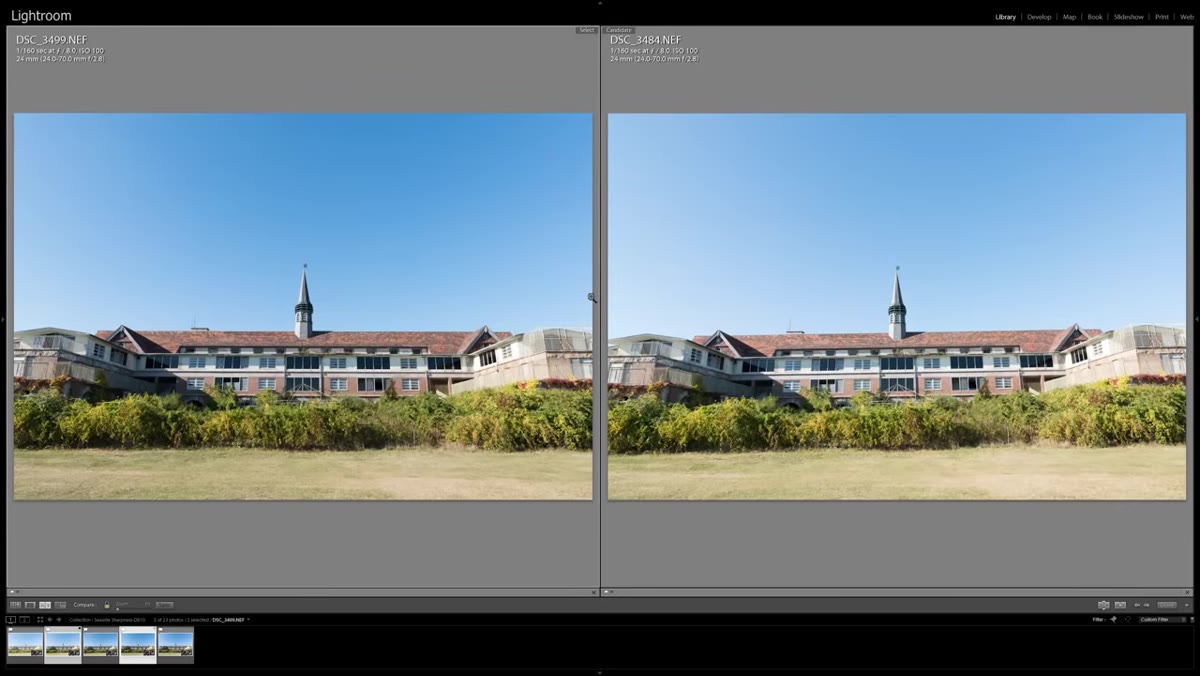
Pull back from the crop and look at the full frames side by side. The Tamron is consistently brighter – about a third of a stop at f/2.8, and the gap grows more noticeable when both lenses are stopped down to f/8. This is a light transmission difference, not exposure compensation. In practice, a camera’s metering system will respond to that extra light by selecting a slightly lower ISO, which gives you marginally cleaner files. It is a small advantage on any single shot, but across a full event shoot it compounds. A lens that gathers more light for the same labeled aperture is genuinely more efficient, regardless of what the f-stop ring says.
Wide-angle view showing Tamron image visibly brighter than Nikon
Pull back from the crop and look at the full frames side by side. The Tamron is consistently brighter – about a third of a stop at f/2.8, and the gap grows more noticeable when both lenses are stopped down to f/8. This is a light transmission difference, not exposure compensation. In practice, a camera’s metering system will respond to that extra light by selecting a slightly lower ISO, which gives you marginally cleaner files. It is a small advantage on any single shot, but across a full event shoot it compounds. A lens that gathers more light for the same labeled aperture is genuinely more efficient, regardless of what the f-stop ring says.
Step 4: Evaluate Sharpness Stopped Down to f/8
 Zoomed-in crop comparison at f/8, both lenses
At f/8, the sharpness gap closes completely. Both lenses resolve fine detail at the same level, and Tony’s honest assessment is that there is no meaningful difference once you stop down. This is the practical cutoff point: if your shooting style keeps you at f/5.6 or narrower – landscapes, architecture, product work – the Nikon’s wide-open softness becomes irrelevant. The Tamron’s sharpness advantage only matters in the aperture range where you are actually using the speed of the lens. Know your own shooting habits before you decide how much this matters to you.
Zoomed-in crop comparison at f/8, both lenses
At f/8, the sharpness gap closes completely. Both lenses resolve fine detail at the same level, and Tony’s honest assessment is that there is no meaningful difference once you stop down. This is the practical cutoff point: if your shooting style keeps you at f/5.6 or narrower – landscapes, architecture, product work – the Nikon’s wide-open softness becomes irrelevant. The Tamron’s sharpness advantage only matters in the aperture range where you are actually using the speed of the lens. Know your own shooting habits before you decide how much this matters to you.
Step 5: Test Autofocus Accuracy Under Real Conditions
 Danny DeVito on a carousel used as moving focus target
This is the moment in the video that gets a little unconventional – they use a carousel ride as a consistent, repeatable moving subject to test autofocus tracking. The speed stays constant, which removes human unpredictability from the equation. The finding is straightforward: no significant difference in autofocus accuracy between the two lenses on the D810 body. If you were expecting the Nikon to pull ahead on its native mount advantage, it does not show up in their testing. Both lenses hunt and lock at a comparable rate under these conditions.
Danny DeVito on a carousel used as moving focus target
This is the moment in the video that gets a little unconventional – they use a carousel ride as a consistent, repeatable moving subject to test autofocus tracking. The speed stays constant, which removes human unpredictability from the equation. The finding is straightforward: no significant difference in autofocus accuracy between the two lenses on the D810 body. If you were expecting the Nikon to pull ahead on its native mount advantage, it does not show up in their testing. Both lenses hunt and lock at a comparable rate under these conditions.
Step 6: Measure Minimum Focus Distance and Watch for Focus Breathing
 Close-up macro comparison showing Nikon achieving greater magnification
Set both lenses to 70mm, manual focus, and wind them to their minimum focus distance. The Nikon achieves greater magnification on the same subject from the same position. The Tamron exhibits noticeable focus breathing – meaning as you focus closer, the effective focal length shortens. Both lenses are labeled 70mm, but up close the Tamron is behaving like something shorter. For most shooting situations this is inconsequential. For anyone doing close product work or wanting maximum background compression in tight portraits, the Nikon’s behavior is more predictable. Focus breathing is a known trait in internal-focus lens designs, and the Tamron shows more of it than the Nikon here.
Close-up macro comparison showing Nikon achieving greater magnification
Set both lenses to 70mm, manual focus, and wind them to their minimum focus distance. The Nikon achieves greater magnification on the same subject from the same position. The Tamron exhibits noticeable focus breathing – meaning as you focus closer, the effective focal length shortens. Both lenses are labeled 70mm, but up close the Tamron is behaving like something shorter. For most shooting situations this is inconsequential. For anyone doing close product work or wanting maximum background compression in tight portraits, the Nikon’s behavior is more predictable. Focus breathing is a known trait in internal-focus lens designs, and the Tamron shows more of it than the Nikon here.
What I’d Add From My Own Testing Experience
I have been comparing lenses in this price class for a while now, and one thing shooters consistently underestimate is how much the vibration control on the Tamron changes the math. The Nikon 24-70 f/2.8 has no stabilization. The Tamron does. In good light, shooting stationary subjects, that difference is invisible. But at the long end of the zoom range, at slower shutter speeds, in available-light situations – that stabilization gives you real insurance. I have seen shooters buy the premium brand lens and then spend another few hundred dollars trying to compensate for its limitations in low light. The Tamron’s built-in VC is not a gimmick; it is a structural advantage that should factor into your cost comparison before you ever open a box.
The single takeaway from this comparison is this: the Tamron is sharper where it counts for fast-aperture shooting, gathers more light than its label suggests, and adds stabilization the Nikon simply does not have – all for $600 less. The Nikon earns its price in flare resistance and focus breathing behavior, but those are narrow use cases. For most Nikon shooters building a working kit on a real budget, the Tamron is the smarter buy.
Watch the full tutorial on YouTube to see the side-by-side frame comparisons and judge the sharpness differences yourself – the visual evidence is more convincing than any description of it.
Comments (1)
Shared this with my photography group. Everyone loved it.
Leave a Comment