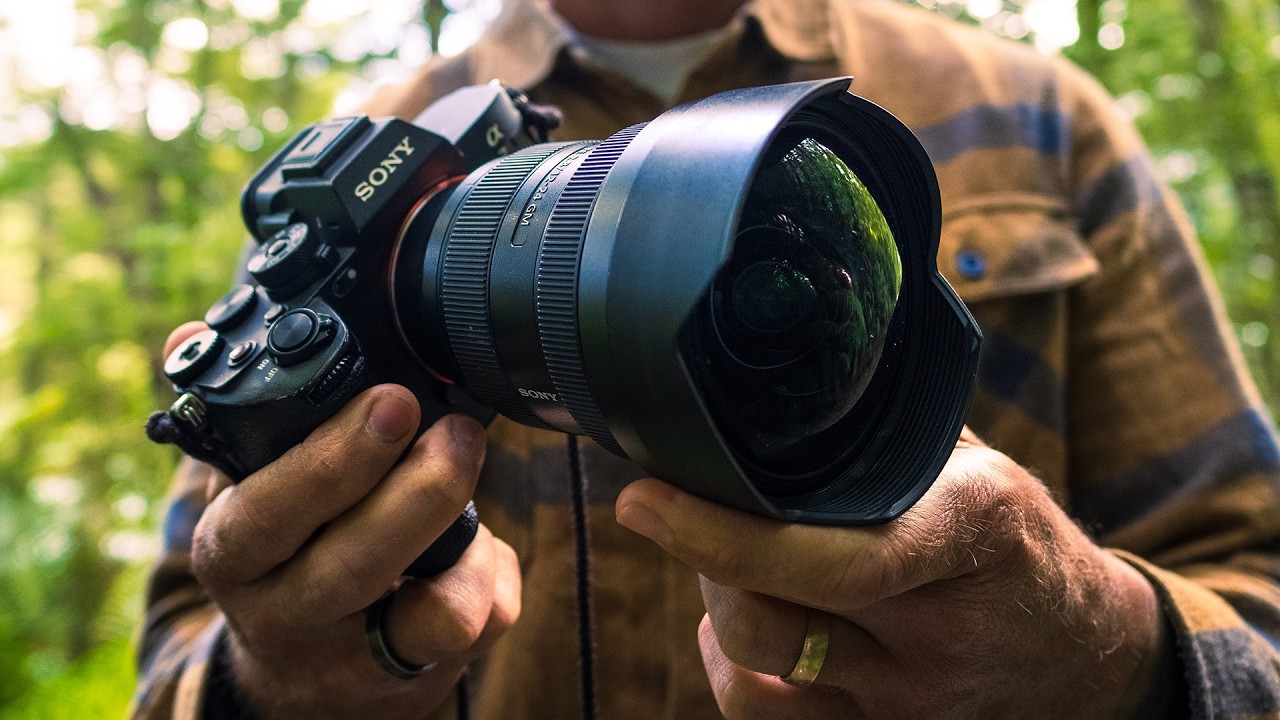
I almost pulled the trigger on this lens twice. The first time, I talked myself out of it by opening my lens comparison spreadsheet and staring at the price column until the urge passed. The second time, I watched this video from William Patino and came away with a much cleaner framework for thinking about whether a flagship ultra-wide actually makes sense for the kind of shooting I do. Spoiler: for most people reading a gear deals site at 7am, it probably doesn’t. But the reasoning matters, so let’s get into it.
What You’re Actually Paying For With the 12-24mm f/2.8
In this William Patino tutorial, he opens by acknowledging something most lens reviewers skip past: the Sony 12-24mm f/2.8 is not competing in a normal market. At roughly $3,300, it’s priced for working professionals who bill enough per shoot to amortize that cost quickly. What you get for that number is a constant f/2.8 aperture across the entire 12-24mm zoom range, which is genuinely rare at this focal length. Most ultra-wides either give you a slower variable aperture, or they’re primes. Having both the zoom flexibility and the fast aperture in one body is the core value proposition here.
Patino is careful to frame this as a tool, not a trophy. The f/2.8 opening means you can shoot astrophotography, real estate interiors, and event work in low light without leaning hard on ISO. That’s not a minor convenience. If you’re shooting a dark venue at 12mm and need sharpness edge-to-edge without pushing to ISO 6400, this lens solves a real problem.
The Optical Performance Breakdown (And Where It Actually Earns Its Price)
Patino walks through sharpness, distortion, and vignetting with enough specificity to be useful. Center sharpness is excellent across the zoom range, which you’d expect at this price. The more meaningful finding is that corner sharpness holds up well even wide open, which is genuinely hard to achieve at 12mm. Ultra-wide corners are where cheap glass falls apart, and this lens doesn’t.
Distortion exists, especially at the 12mm end, but it’s the kind that Sony’s in-camera and Lightroom corrections handle cleanly. If you’re shooting architecture and need perfectly straight lines, you’ll be applying corrections anyway. If you’re shooting landscapes or astro, barrel distortion at 12mm is rarely your problem.
Vignetting at f/2.8 is present but, again, correctable. Patino’s honest take is that for most use cases, the optical profile of this lens is so well-mapped by correction profiles that the raw files are almost beside the point. What comes out of Lightroom is clean.
The Bulbous Front Element Problem Nobody Talks About Enough
Here’s where Patino earns the “honest” label in the video title. The 12-24mm f/2.8 has a bulbous front element, which means it cannot accept screw-on filters. No ND filters. No polarizers. For landscape photographers especially, this is a genuine workflow limitation, not a minor footnote.
If you shoot waterfalls, seascapes, or any scenario where you’d normally reach for a 6-stop ND, you either need a specialized drop-in filter system designed for this lens (which adds cost and complexity) or you adapt your technique entirely. Patino doesn’t dismiss this, and neither will I. I’ve shot enough mountain scenics here in Colorado to know that a polarizer at high altitude is practically load-bearing. Losing that option changes how you work.
This is the detail that pushed me toward primes for my own ultra-wide shooting. The Laowa 10mm prime Patino mentions as a comparison point is a fraction of the price and, while it lacks the zoom range, it accepts filters like a normal lens. For anyone whose shooting style depends on filtration, that tradeoff is worth thinking through before committing.
Who This Lens Actually Makes Sense For
Patino lands on a sensible target user: the professional photographer who regularly shoots in multiple wide-angle focal lengths under low-light conditions and needs the reliability of a single lens rather than swapping glass. Think wedding photographers covering dark reception halls, event shooters working unpredictable venues, or photojournalists who need that 12-24mm range without carrying two bodies.
If that’s you, the price becomes easier to justify because the alternative is either carrying multiple lenses or compromising on aperture. The f/2.8 constant aperture is doing real work in those scenarios.
If you’re a landscape or astro photographer who mostly shoots from a tripod, works in reasonable light, and values filter compatibility, the case weakens considerably. You’re paying a premium for low-light performance you may rarely need, while losing filter flexibility you use constantly.
Where I’d Push Back Slightly
My one genuine addition to Patino’s framework: don’t sleep on the rental option before buying. I ran this exact calculation before my last wide-angle purchase. At the rental rates available right now through most major platforms, you can shoot this lens for a full weekend trip for about $80-100. If you come back from that trip wishing you owned it, you have real data. If you come back thinking “yeah, my current glass was fine,” you just saved yourself $3,200.
I’ve bought lenses I regretted and lenses I wished I’d bought sooner. The ones I regretted almost always skipped the rental test. The value-versus-prestige question Patino keeps returning to in the video is a good one, and renting first is the cleanest way to answer it honestly for your own work.
The Sony 12-24mm f/2.8 is not overpriced for what it is. It’s just priced for a specific professional need, and most of us don’t have that need often enough to justify the cost. Watch the full video for Patino’s sample footage and side-by-side comparisons, which make the optical performance argument far more viscerally than I can in text.
Comments
Leave a Comment