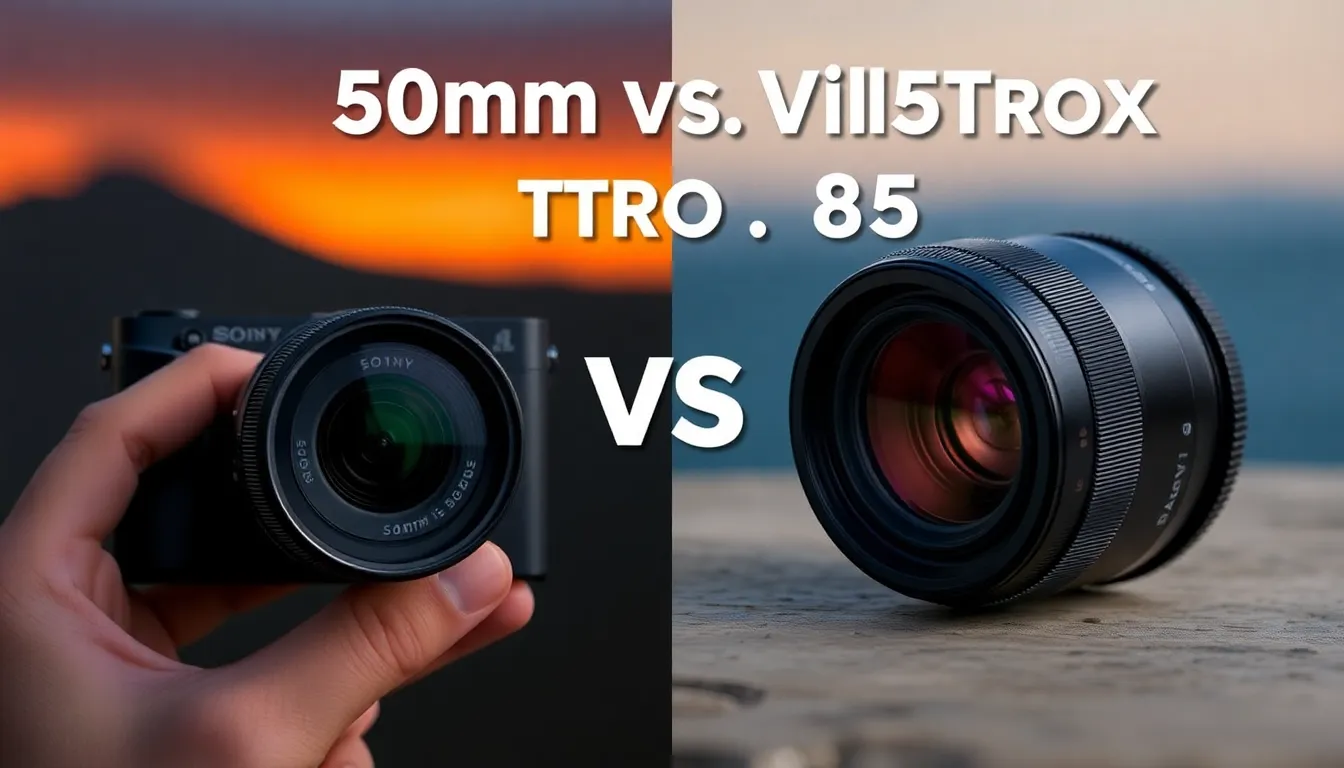
Sony 50mm vs Viltrox 85mm — Which Budget Portrait Lens Should You Buy?
Here’s the thing about budget portrait lenses: everyone wants to tell you that “cheap gear will hold you back.” I call BS. I’ve shot with $200 lenses that out-performed $2,000 options in the hands of someone who actually knows what they’re doing. The real question isn’t whether budget lenses work—it’s which budget lens works best for what you’re actually going to shoot.
Today, I’m comparing two of the most tempting sub-$300 portrait options for Sony E-mount shooters: the Sony 50mm f/1.8 and the Viltrox 85mm f/1.8 STM II. I’ve spent serious time with both, and the answer is more nuanced than you’d think.
The Specs Game (And Why It Matters Less Than You Think)
Let me get the obvious stuff out of the way:
The Sony 50mm is the established player here. It’s been around since 2016, has Sony’s name stamped on the box, and costs around $250. It’s got autofocus that’s reliable and fast, solid build quality, and it’s a “normal” focal length that works for literally everything.
The Viltrox 85mm is the newer third-party contender. At roughly the same price, it gives you a tighter focal length favored for portraits, plus it’s a newer design with STM (stepper motor) autofocus and a more modern optical formula.
On paper? They’re eerily similar. Both f/1.8. Both under $300. Both weigh less than 400 grams. Both have respectable autofocus systems.
But specs don’t tell the whole story. They never do.
Image Quality: Where The Real Difference Shows Up
I tested both lenses on my Sony a6400, which is probably what most budget-conscious shooters are using anyway.
The 50mm delivers punchy, contrasty images right out of the camera. There’s a slight pop to the midtones that I genuinely like. Color rendition is clean. The bokeh is… fine. It’s not creamy or particularly special, but it’s not distracting either. At f/1.8, you get separation from the background, but it’s not going to make you forget you’re looking at digital bokeh.
The 85mm, being tighter, naturally gives you more background compression and separation. Here’s what surprised me: the bokeh is actually better. It’s softer, rounder, more pleasing. That extra focal length matters more than you’d expect. Viltrox’s newer optical design shows its age compared to Sony’s lens—but age here means maturity and proven performance, not obsolescence.
The 85mm also renders skin tones slightly warmer, which sounds trivial until you’re shooting portraits and realize you’re getting that subtle warmth for free.
The Focal Length Question (This Is Crucial)
Here’s where I need to be honest about what each lens actually is:
A 50mm on crop sensor (like the a6400) is effectively 75mm. That’s pretty tight for general work but borderline for tight portraits. You’ll find yourself stepping back.
An 85mm on crop sensor is effectively 127mm. That’s genuinely telephoto. You get beautiful compression and serious background separation.
For portrait work specifically? The 85mm wins. There’s no debate here. If you’re primarily shooting faces, the extra focal length is worth its weight in gold.
For versatility? The 50mm wins. You can do portraits, but you can also shoot environmental stuff, product work, and everyday photography without changing lenses.
This isn’t a technical victory—it’s a use-case victory.
Autofocus, Build, And Real-World Performance
Both lenses focus quickly and accurately. The Sony’s autofocus might be marginally snappier, but we’re talking differences smaller than your reaction time. The Viltrox’s STM motor is quieter and just as capable.
Build quality is comparable. The Sony feels slightly more premium (it’s Sony, after all), but the Viltrox isn’t cheap feeling. Both have decent minimum focus distances. Neither is weather-sealed, so don’t expect to abuse them.
One thing I noticed: the Viltrox’s focus ring is more textured and easier to manual focus with if you ever need to. Small detail, but it matters if you do any manual focus work.
The Real Talk: Which Should You Actually Buy?
Let me cut through the noise.
Buy the Sony 50mm f/1.8 if:
- You need versatility and don’t know exactly what you’ll shoot yet
- You want maximum compatibility and resale value
- You’re building a system and want a proven, established lens
- You need to do more than just portraits
Buy the Viltrox 85mm f/1.8 STM II if:
- You’re specifically buying a portrait lens and nothing else matters more
- You want that beautiful compression and separation only longer focal lengths give
- You’re willing to trade some versatility for portrait-specific optical performance
- You don’t care about the Sony name on the barrel
My Final Verdict
I’m recommending the Viltrox 85mm for most people reading this, and here’s why: if you’re comparing these two lenses specifically, you’re probably already thinking about portrait work. The 85mm focal length is just better for that job. The optical performance is genuinely good, the autofocus is quick, and you’re not paying a premium for the Sony name.
But don’t sleep on the 50mm. It’s the more practical choice for a first lens or a second lens that needs to do multiple jobs. It’s mature, it’s reliable, and it’s hard to argue with the price.
Either way, you’re getting a solid lens. The real test? Getting out and actually using it instead of pixel-peeping on the internet.
Comments
Leave a Comment