
If you shoot Sony full-frame mirrorless and you’ve been quietly resenting the price tags on native glass, this announcement is the one you’ve been waiting for. I’ve spent more time than I’d like to admit cross-referencing lens prices across every deals site I follow, and the pattern is always the same: Sony’s own glass is sharp but expensive, third-party options are cheaper but often sketchy on autofocus compatibility. Tamron has been quietly dismantling that trade-off, and their latest announcement blows the door wide open.
In this The Slanted Lens breakdown, Jay P. Morgan walks through four newly announced Tamron lenses built natively for Sony E-mount full-frame cameras. Three fast prime wide-angles and the long-awaited telephoto zoom to complete the series. What caught my attention wasn’t just the specs. It was how intentionally these lenses were designed to work together as a system, which is exactly the kind of thinking that makes a real difference when you’re building out a kit on a budget.
Watch the full tutorial on YouTube
Step 1: Understand What the 70-180mm f/2.8 Actually Completes
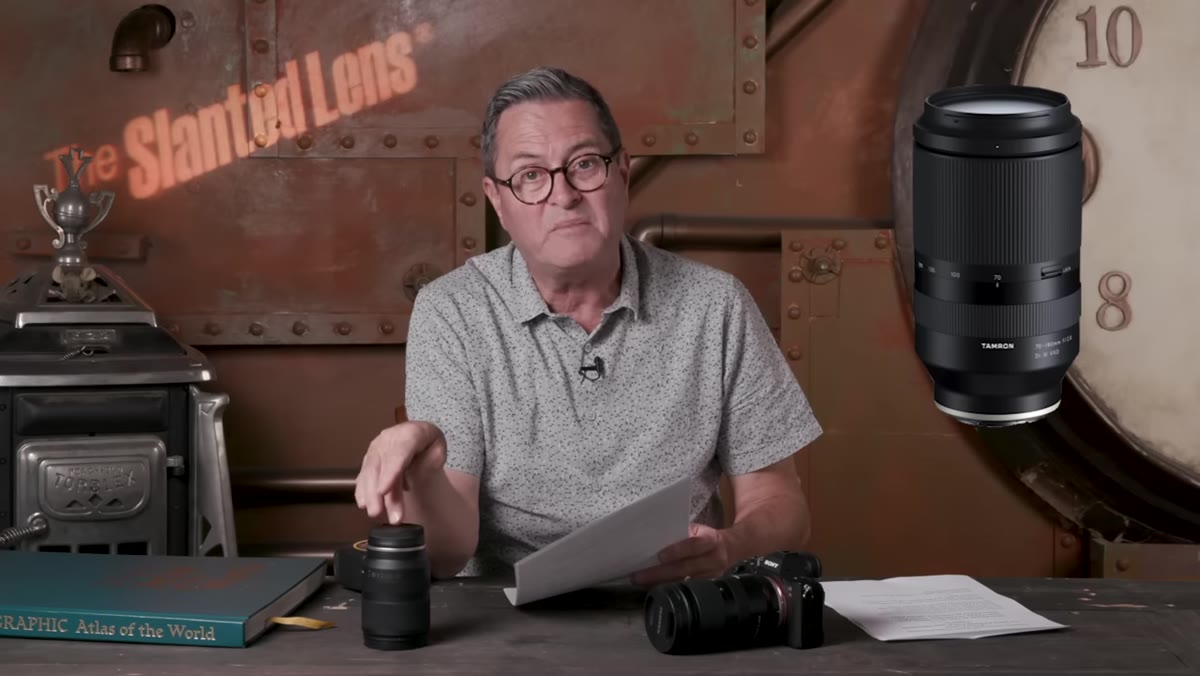
 Host introducing the 70-180mm as the final series lens
The 70-180mm f/2.8 is the piece Tamron needed to finish what most photographers call a “holy trinity” of zoom lenses. The other two, a 17-28mm f/2.8 and a 28-75mm f/2.8, were already available. This telephoto zoom closes the gap and gives Sony mirrorless shooters a complete wide-to-tele f/2.8 zoom set from a single manufacturer, at prices that don’t require a payment plan.
Host introducing the 70-180mm as the final series lens
The 70-180mm f/2.8 is the piece Tamron needed to finish what most photographers call a “holy trinity” of zoom lenses. The other two, a 17-28mm f/2.8 and a 28-75mm f/2.8, were already available. This telephoto zoom closes the gap and gives Sony mirrorless shooters a complete wide-to-tele f/2.8 zoom set from a single manufacturer, at prices that don’t require a payment plan.
For shooters on a Sony A7 III, A7R III, or A7R IV, this matters because all three lenses are designed to take full advantage of the camera’s native autofocus system, including eye-tracking and phase-detect AF. You’re not sacrificing any of the camera’s core features to save money on glass.
Step 2: Appreciate How Compact the Zoom Series Actually Is
 Host holding up lens to demonstrate 5.25-inch length
One of the strongest arguments for going mirrorless is the size reduction. But that argument falls apart if you mount a large, heavy lens on the front of a compact body. The 17-28mm and 28-75mm in this series clock in around 5.25 inches in length. The new 70-180mm adds roughly half an inch, landing near 5.9 inches. For a telephoto zoom with a constant f/2.8 aperture, that is genuinely small.
Host holding up lens to demonstrate 5.25-inch length
One of the strongest arguments for going mirrorless is the size reduction. But that argument falls apart if you mount a large, heavy lens on the front of a compact body. The 17-28mm and 28-75mm in this series clock in around 5.25 inches in length. The new 70-180mm adds roughly half an inch, landing near 5.9 inches. For a telephoto zoom with a constant f/2.8 aperture, that is genuinely small.
I keep a running spreadsheet of every budget lens I’ve tested, and size-to-performance ratio is one of the columns I track. A lens that fits easily in a sling bag alongside two other lenses is worth more in practice than a sharper lens that makes your kit feel like a workout. Tamron clearly thought about this.
Step 3: Factor in the Shared 67mm Filter Thread
 Host explaining unified 67mm filter size across all lenses
This is the detail that most announcement articles skim past, but it’s the one that actually saves you money over time. All three zoom lenses in this series share a 67mm filter thread. That means one set of filters covers your entire zoom kit: ND filters, polarizers, graduated ND filters for landscape work, all of it.
Host explaining unified 67mm filter size across all lenses
This is the detail that most announcement articles skim past, but it’s the one that actually saves you money over time. All three zoom lenses in this series share a 67mm filter thread. That means one set of filters covers your entire zoom kit: ND filters, polarizers, graduated ND filters for landscape work, all of it.
If you’ve ever bought a polarizer for one lens and then had to buy another for a different diameter, you know how fast that adds up. Standardizing on 67mm across a full zoom system is a practical, user-focused design choice. It’s the kind of thing I wish more manufacturers thought about.
Step 4: Meet the Three New Prime Wide-Angles
 Host describing the 20mm, 24mm, and 35mm prime lineup
Separate from the zoom series, Tamron announced three prime lenses: a 20mm f/2.8, a 24mm f/2.8, and a 35mm f/2.8. All three are built for Sony full-frame E-mount. The physical size on these is where things get interesting. They’re roughly 2.5 inches tall, which is small enough that you could reasonably mistake one for a lens cap sitting on a table.
Host describing the 20mm, 24mm, and 35mm prime lineup
Separate from the zoom series, Tamron announced three prime lenses: a 20mm f/2.8, a 24mm f/2.8, and a 35mm f/2.8. All three are built for Sony full-frame E-mount. The physical size on these is where things get interesting. They’re roughly 2.5 inches tall, which is small enough that you could reasonably mistake one for a lens cap sitting on a table.
These aren’t f/1.4 or f/1.8 lenses, and that’s a fair thing to flag. But f/2.8 on a full-frame sensor still gives you meaningful subject separation and solid low-light capability, especially paired with Sony’s in-body image stabilization. For street photography, travel, or any situation where you want fast, light, and unobtrusive glass, this trio makes a real argument.
Step 5: Lock In the Price Point and Think About What That Means
 Host announcing approximately $349 price per prime lens
Each of the three primes is expected to land around $349. That price point positions them well below Sony’s own Zeiss-branded primes and most comparable options from other third-party manufacturers. At that price, buying all three costs about the same as a single mid-range Sony prime.
Host announcing approximately $349 price per prime lens
Each of the three primes is expected to land around $349. That price point positions them well below Sony’s own Zeiss-branded primes and most comparable options from other third-party manufacturers. At that price, buying all three costs about the same as a single mid-range Sony prime.
For photographers who build kits the way I do, starting from a specific budget and working outward, $349 per lens means these are realistic purchases, not aspirational ones. And because Tamron is building these with full native autofocus compatibility, you’re not compromising on camera performance to hit that number.
Step 6: Watch for the Early 2020 Release Window
 Host mentioning early 2020 availability for the 70-180mm
The 70-180mm f/2.8 zoom was confirmed for an early 2020 release, with plans to display it at PhotoPlus in New York City before launch. The three primes were announced alongside it. If you’re planning a kit purchase, this is worth timing carefully. First-run pricing on Tamron lenses tends to be competitive, and deals sites often pick up introductory discounts around launch windows.
Host mentioning early 2020 availability for the 70-180mm
The 70-180mm f/2.8 zoom was confirmed for an early 2020 release, with plans to display it at PhotoPlus in New York City before launch. The three primes were announced alongside it. If you’re planning a kit purchase, this is worth timing carefully. First-run pricing on Tamron lenses tends to be competitive, and deals sites often pick up introductory discounts around launch windows.
Set up price alerts now on the lenses you’re targeting. By the time availability is confirmed, you’ll know exactly what a fair price looks like and won’t have to scramble to decide.
What I’d Add From My Own Testing
The 28-75mm f/2.8 has been in my own rotation for several months, and it’s the lens that convinced me Tamron’s approach to this Sony lineup is serious. The autofocus on that lens kept up with everything I threw at it, including a fast-moving subject in mixed light. Based on that experience, I have no reason to doubt the claims being made about the 70-180mm.
The prime trio is the more interesting gamble to me. At $349 each with f/2.8 apertures, they live in a space where the competition is either slower, more expensive, or less reliably compatible with Sony’s AF system. If the optical quality lands anywhere near the zoom series, they fill a genuine gap for photographers who prefer primes but can’t justify spending $800 or more per focal length.
The single most important thing this announcement signals is that building a complete, high-performing Sony full-frame kit without spending Sony prices is no longer a compromise. It’s a real option. Tamron is doing the work, and these lenses are the proof.
Watch the full tutorial on YouTube for Jay P. Morgan’s full breakdown, including his hands-on impressions from PhotoPlus.
Comments (2)
The tip about tamrons 4 new sony e mount len was the missing piece for me. Thank you.
Couldn't agree more. I've seen this make a huge difference in lighting work specifically.
Leave a Comment